
Let's Read: Beowulf
Tolkien vs. Headley; Lo! vs. Bro!
While I prepare for a return to the mythic lands of Stonetop, I offer for your consideration a new entry in the series my Horatius at the Bridge essay began — I’m going to start calling these pieces “Let’s Read” — deep readings of rich texts, be they ancient sagas, Victorian poetry, or perhaps, TTRPG rulebooks with particularly sharp insights into storygaming. If you have any thoughts on things it’d be interesting to read together, share ‘em in the comments!
Today we’re reading the prologue to Beowulf — not the whole poem, just first eighty-odd lines of prologue, the part before Beowulf himself shows up to fight the monstrous Grendel. It’s work that any fantasy or sci-fi storyteller is familiar with: Worldbuilding. It tells the origin story of the Danish royal house, from rags to riches to a doomed fate that’s only hinted at, all to set the stage for Beowulf’s confrontation with Grendel.
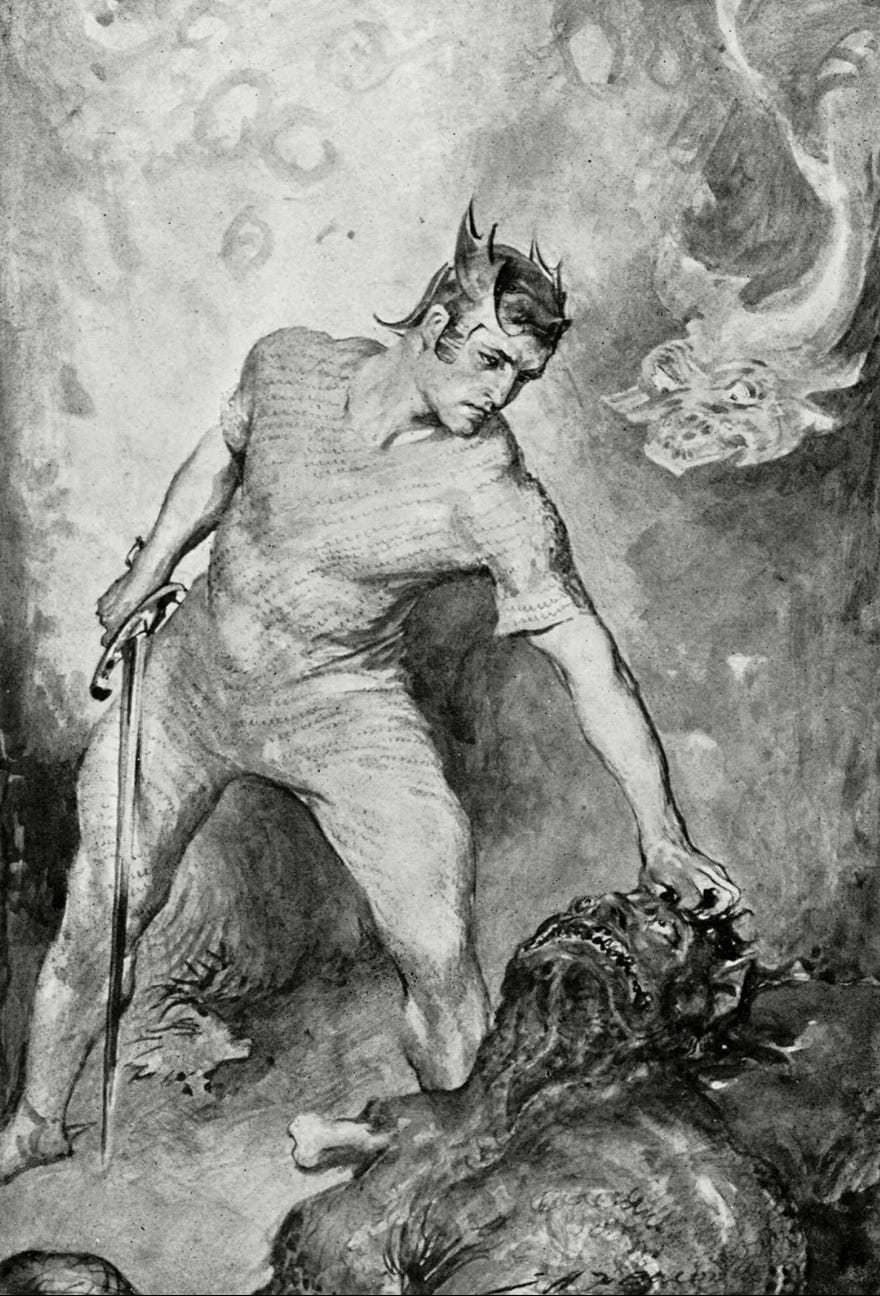
Unlike Horatius at the Bridge, which conveniently tells a Roman story in the Queen’s English, Beowulf is in Old English, which means that for us moderns, the story must be translated. The translator we choose deeply shapes how we experience the poem, so I’m putting two translations side by side: J.R.R. Tolkien’s prose version, composed starting in 1920 by a man who understood the poem better than anyone alive in the twentieth century, and Maria Dahvana Headley’s 2020 verse translation, written by a novelist who wanted to strip away the reverence and make the poem sound like something you’d hear at a sports bar. Tolkien did his utmost to preserve the restrained reverence of the original Old English and hewed close to the literal meanings of the ancient words, while Headley threw much of that to the wind to modernize it and make it leap off the page with energy.
The truth is that this story contains elements of both: It’s reverential and celebratory, it’s religious and raucous, and by looking at these two translations side-by-side, we can drink deep from both cups.
Hwæt!
Beowulf begins with a famous word — hwæt. It’s generally translated as a shout. An attention-grabber. The scop — the Anglo-Saxon poet-performer — steps up in the mead-hall, and before he begins his tale, he hollers at the crowd to shut up and listen. Translators rendered it as “So,” or “Listen!” or “Hear me!” or “Attend!” or, in one 1892 version by John Earle that Tolkien himself mocked, “What ho!” Let’s see how our two translators render this:
Tolkien:
Lo! the glory of the kings of the people of the Spear-Danes in days of old we have heard tell, how those princes did deeds of valour.
Straight at it. The storyteller bids us remember the kings of old. Now, Headley — this first word translation is perhaps her most controversial choice:
Headley:
Bro! Tell me we still know how to speak of kings! In the old days,
everyone knew what men were: brave, bold, glory-bound. Only
stories now, but I’ll sound the Spear-Danes’ song, hoarded for
hungry times.
Bro! Reasonable readers can disagree, of course, but I love this opening gambit. Her translation gives the narrator a point of view — wistful for the great days of old, eager to share a tale of glory with people who might be starving for it. Headley’s a very progressive translator, and you wouldn’t be wrong if you read some snark in what she’s doing here, but for me, in these hungry times, the elevated masculinity of it all is welcome.
This pair of translations establishes a pattern that persists throughout (and that I won’t belabor): Tolkien’s rendering is much closer to the original Old English than Headley’s.
To illustrate: the Old English opens with wē... gefrūnon — “we have heard tell.” Tolkien keeps it exactly. Headley transforms it into a first-person exhortation: “Tell me we still know how to speak of kings!” Similarly, the Old English says nothing about what men were — lines 1–3 say only that we've heard of the Spear-Danes' glory and their princes' deeds of valor. Headley's "everyone knew what men were: brave, bold, glory-bound" is her invention, as is "only stories now" and "hoarded for hungry times." Inventions though they may be, I love them—evocative, emotionally specific—but they're Headley's voice, not the original poet's. Tolkien's "the glory of the kings of the people of the Spear-Danes in days of old" might be clunky by modern standards, stacking ‘of’s in a way no contemporary writer would choose, but it’s that formal cadence that gives the translation its feeling of ancient nobility.
Next, we hear about one of those storied kings — Scyld Scefing. Here’s Tolkien, giving it to us straight:
Tolkien:
Oft Scyld Scefing robbed the hosts of foemen, many peoples, of the seats where they drank their mead, laid fear upon men, he who first was found forlorn; comfort for that he lived to know, mighty grew under heaven, throve in honour, until all that dwelt nigh about, over the sea where the whale rides, must hearken to him and yield him tribute—a good king was he!
This is one giant sentence that gives us the rise of Scyld — from foundling (“first was found forlorn”) to fearsome warrior who took many mead-halls, to king accepting tribute. The scop likely delivered it in a single breath to emphasize the legacy that’s being established. Tolkien preserves the original poet’s restraint, but with some beautiful language: mighty grew under heaven; throve in honour, over the sea where the whale rides.
Here’s Headley’s version of the same:
Headley:
Their first father was a foundling: Scyld Scefing.
He spent his youth fists up, browbeating every barstool-brother, bonfiring his enemies.
That man began in the waves, a baby in a basket,
But he bootstrapped his way into a kingdom, trading loneliness
for luxury. Whether they thought kneeling necessary or no,
Everyone from head to tail of the whale-road bent down:
There’s a king, there’s his crown!
That was a good king.
Meanwhile, Headley paints with bolder colors. The alliteration, present in Tolkien’s, is dialed up and delightful: first/father/foundling, and then ladles it on further with vivid imagery of Scyld’s warrior spirit: Fists up, browbeating barstool-brothers, bonfires of his enemies. Badass.
Kennings!
There’s another key difference between these two passages — their reference to the sea. Tolkien writes “where the whale rides,” and Headley gives us “the whale-road.” “Whale-road” is an Old English construction known as a kenning, one of my favorite things about readings old Norse and English writing.
A kenning is a compressed metaphor — two words fused into a compound that replaces a common noun with something stranger and more vivid. The sea is the whale-road. Your body is your bone-house. Blood is battle-sweat. Death is the sword-sleep. Each one is a little riddle that asks the listener to see a familiar thing from an unfamiliar angle.
Kennings are one place where Headley’s translation hews closer to the original Old English than Tolkien’s. J.R.R. chooses to ‘unpack’ the kenning in the prose, rather than leaving it as a tight, slightly obscure compound word. He sharply defends this choice in his translator’s commentary:
Nonetheless it is quite incorrect to translate it (as it is all too frequently translated) ‘whale road’. It is incorrect stylistically since compounds of this sort sound in themselves clumsy or bizarre in modern English, even when their components are correctly selected. In this particular instance the unfortunate sound-association with ‘railroad’ increases the ineptitude.
All respect to the great professor, but I think his hatred of railroads might be coloring his judgment here. Tolkien was famously anti-modern—his villain, Saruman, is described as having a ‘mind of metal,’ and puts torch and axe to Fangorn forest to industrialize his operations at Isengard.
Scyld’s Heir
Once we’ve established Scyld’s rise to kingship, we then track his lineage to the present moment:
Tolkien
To him was an heir afterwards born, a young child in his courts whom God sent for the comfort of the people: perceiving the dire need which they long while endured aforetime being without a prince. To him therefore the Lord of Life who rules in glory granted honour among men: Beow was renowned—far and wide his glory sprang—the heir of Scyld in Scedeland. Thus doth a young man bring it to pass with good deed and gallant gifts, while he dwells in his father’s bosom, that after in his age there cleave to him loyal knights of his table, and the people stand by him when war comes. By worthy deeds in every folk is a man ennobled.
Scyld’s descendants are framed by the poet as divine providence — Denmark had languished without a great ruler, but no longer: God granted them an heir who upheld Scyld’s legacy and won the loyalty of his father’s men.
Now let’s look at Headley’s:
Headley
Later, God sent Scyld a son, a wolf cub,
further proof of manhood. Being God, He knew
how the Spear-Danes had suffered, the misery
they’d mangled through, leaderless, long years of loss,
so the Life-lord, that Almighty Big Boss, birthed them
an Earth-shaker. Beow’s name kissed legions of lips
by the time he was half-grown, but his own father
was still breathing. We all know a boy can’t daddy
until his daddy’s dead. A smart son gives
gifts to his father’s friends in peacetime.
When war woos him, as war will,
he’ll need those troops to follow the leader.
Privilege is the way men prime power,
the world over.
There’s so much I love in this passage: ‘The Life-lord, that Almighty Big Boss, birthed them an Earth-shaker’ is very far from the original Old English, but it thrums with prophecy. “[His] name kissed legions of lips” is a fun and slightly sexy way to describe widespread fame. And the line “We all know a boy can’t daddy until his daddy’s dead” burrowed into my brain when I read this book in the aftermath of my own father’s death.
A note about the tension between Christianity and Paganism at play here and elsewhere throughout the poem: Beowulf was almost certainly written down by a Christian poet, but it tells a story about pagan Scandinavians. Whoever wrote the story down made the cosmology of the world unambiguously Christian: God sends Scyld to the Danes, Grendel is descended from Cain, and so forth. But nobody in this story is Christian, and the poet who first wrote it down very likely believed that every character in this story was bound for hell. Despite that, the poet clearly loves these people and their world; Seemingly, ancient Christians were less susceptible to presentism than we moderns.
The final lines, though, land flat for me. When you look at Tolkien’s more faithful translation: “…There cleave to him loyal knights of his table, and the people stand by him when war comes. By worthy deeds in every folk is a man ennobled.” This is a statement of principles, a description of how a righteous, open-handed king builds a noble and loyal court of followers. In Headley’s translation, this is rendered as transaction: Privilege is the way men prime power. It’s a great turn of phrase, but it intentionally undermines the nobility it depicts.
Headley would argue this undercutting has warrant in the original — in her introduction, she tells us the Beowulf poet himself periodically undercuts his heroes, commenting on men who've "discerned nothing about blood relatives' treachery and their own heathen helplessness." Fair enough — a Christian poet elegizing doomed pagans is already standing outside the heroic frame. But the poet's irony is tragic; he loves these people and mourns what's coming. Headley's, here, is deflationary — it doesn't grieve the thing it diminishes.
Next, we get Scyld’s funeral — a worthy send-off for the first king of the Spear-Danes:
Tolkien:
Then at his allotted hour Scyld the valiant passed into the keeping of the Lord; and to the flowing sea his dear comrades bore him, even as he himself had bidden them, while yet, their prince, he ruled the Scyldings with his words: beloved lord of the land, long was he master. There at the haven stood with ringéd prow, ice-hung, eager to be gone, the prince’s bark; they laid then their beloved king, giver of rings, in the bosom of the ship, in glory by the mast.
The classic ‘Viking funeral’ (though these Danes predate the Viking Age by several centuries) — the king arrayed with a great treasure in a longship. Here, Tolkien’s language is quite difficult to parse as a modern reader, whereas Headley’s gives us a bit more to play with:
Scyld was iron until the end. When he died,
his warriors executed his final orders.
They swaddled their king of rings and did
just as the Dane had demanded, back when mind
and meter could merge in his mouth.
They bore him to the harbor, and into the bosom
of a ship, that father they’d followed,
that man they’d adored. She was anchored and eager
to embark, an ice maiden built to bear
the weight of a prince. They laid him
by the mast, packed tight in his treasure-trove,
bright swords, war-weeds, his lap holding a hoard
of flood-tithes, each fare-coin placed by a loyal man.
He who pays the piper calls the tune.
Lots to love here: “Iron until the end,” is great. “Mind and meter could merge in his mouth,” is a beautiful description of lucidity and a nice reminder that the ancients tightly connected speech and rulership. The depiction of the frost-covered ship as an ice-maiden, eager to embark is beautiful—like modern English sometimes does, Old English gendered ships as feminine, which is the source of Headley’s rendition here. Just as in the previous excerpt, Headley paints an incredible picture, and then kneecaps it with the final line — ‘he who pays the piper calls the tune,’ boiling down all that loyalty, honor, and filial love into simple mercenary behavior.
The next generation
After Scyld is given to the waves, we get a quick recounting of his lineage. Here’s the old professor:
Tolkien
Then in the strongholds long was Beow of the Scyldings, beloved king of men, renowned among peoples—elsewhere had the prince his father departed from his home—until thereafter he begat Healfdene the high, who held the lordship while he lived, aged and fierce in war, over the fair Scyldings. To him were children four born in the world, in order named: captains of the hosts, Heorogar, and Hrothgar, and Halga the good; and [a daughter] I have heard that was Onela’s queen, dear consort of the warrior Scylfing.
So, Scyld begat Beow, who begat Healfdene, who begat three sons, including Hrothgar (the king whom Grendel torments when the story begins in earnest), and a single daughter, whose name is lost — Tolkien’s squared brackets indicate the manuscript was damaged in precisely this place, and translators assume based on context that this was a woman’s name.
Note how Headley handles the same genealogy:
Headley
Finally, Beow rolled into righteous rule,
daddying for decades after his own daddy died.
At last, though, it was his turn for erasure:
his son, the Halfdane, ran roughshod, smothering
his father’s story with his own. He rose in the realm
and became a famous warlord, fighting ferociously
dawn to dusk, fathering his own horde of four,
heirs marching into the world in this order: Heorogar,
Hrothgar, Halga, and I heard he hand-clasped his
daughter
(her name’s a blur) to Onela. Tender, she rendered that battle-Swede
happy in fucking, where before he’d only been happy in fighting.
Headley introduces this interesting notion of ‘erasure’ — the rapid-fire nature of this genealogy makes us feel a bit like each king is forgotten by the time we read about the next king.
Then, we see how she tackles the missing name — she lampshades it with ‘her name’s a blur,’ a fun little joke for the folks who dig deep. And “Happy in fucking, where before he’d only been happy in fighting” seems like an aspirational marriage, be you a Substacker or a Spear-Dane.
The building of Heorot
Now Hrothgar becomes king, and he will build a great meadhall (which attracts the attention of the monstrous Grendel and then the mighty Beowulf):
Tolkien
Thereafter was fortune in war vouchsafed to Hrothgar, and glory in battle, that the vassals of his own kindred hearkened willingly unto him and the numbers of his young warriors grew to a mighty company of men. Then it came into his heart that he would command men to fashion a hall and a mansion, a mightier house for their mead-drinking than the children of men had ever known, and there-within would he apportion all things to young and old such as God had granted him, save the people’s land and the lives of men.
This passage contains within it some moral instruction: Hrothgar, as king, used his wealth to build a mead-hall for his company, and once the hall is complete, he intends to give away all of his war-won treasure: ‘‘all things to young and old such as God had granted him,” but it tells us what a king must never give away heedlessly: The lives of his men, and the people’s land he governs.
As we’ve seen in the past comparisons, Headley makes this passage incredibly compelling, but throws shade at its moral content:
War was the wife Hrothgar wed first. Battles won,
treasures taken. Admirers and kin heard of his fight-fortune,
and flanked him in force. Strong boys grow into stronger men,
and when Hrothgar had an army, his hopes turned to a hall
to home them—a house to espouse his faithful.
More than just a mead-hall, a world’s wonder,
eighth of seven. When it was done, he swore,
he’d load-lighten, unhand everything he’d won,
worn, and owned, pass to his posse all God’s gifts,
save lives and land. He’d keep the kingdom, of course.
‘He’d keep the kingdom, of course’ — Once again, this idea of noble obligation is painted over with selfishness. Hrothgar will give up everything, except, of course, power.
We’ll stick with Headley for the final handful of lines:
Headley
He gave far-reaching orders: carpets, carpentry, walls and gables,
tables for seating a clan, rare gifts plated like rare meat,
all for his men. So it rose: a greater hall than any other!
Hrothgar filled it, blood-brother by blood-brother,
and named it Heorot. His words were heard and heralded,
and yes, yes, bro! The man was more than just talk:
he gave good gifts. His war-wedded wore kings’ rings,
and drank their leader’s mead. Nightly, he feted his fight-family
with fortunes. The hall loomed, golden towers antler-tipped;
it was asking for burning, but that hadn’t happened yet.
You know how it is: every castle wants invading, and every family
has enemies born within it. Old grudges recrudesce.
Yes, yes, bro! Headley’s Heorot is a place I want to be. Filled with blood-brothers, war-wedded, and fight-family, with nightly feasts. Heorot literally means “Hart,” the male deer, and Headley shows us that with its ‘golden towers antler-tipped.’
The final lines foretell the burning of Heorot—not at Grendel’s hands, but in a feud between families. Supernatural evil can be defeated by a great warrior, but kin-strife is far more insidious. Here's Tolkien's version of that moment:
Tolkien
The hall towered high with hornéd gables wide, awaiting the warring billows of destroying fire: the time was not far off that between father and daughter's spouse murderous hate in memory of a deadly feud should awake again.
In Headley’s version, Heorot is ‘asking for burning,’ while in Tolkien’s, it merely ‘awaits’ its fate in the not far-off future.
Here, Headley’s editorializing—‘you know how it is’—takes a specific prophecy and universalizes it: Every castle wants invading, and every family has enemies born within it. It undercuts the grandness of the poet’s pronouncement of doom on glorious Heorot, but unlike the examples above, this one works for me. The earlier examples — ‘he who pays the piper…’ and ‘he’d keep the kingdom, of course…’ reduce old-school honor to mere transaction. “Every castle wants invading; and every family has enemies within it,” on the other hand, has some ring of truth, tragedy, even if it is a bit cynical and world-weary.
Which way, modern Beowulf reader?
That's our prologue — a foundling king, a funeral ship sailing into mystery, a dynasty rising, and a golden hall built for joy and fated for fire, all before the hero of the poem even shows up. If you've made it this far, thank you for reading along.
So, if you decide to read Beowulf, either for the first time or once again, which translation should you go with? Both, side-by-side, of course—but if I had to put one in your hands, it’d be Headley’s.
I know I just spent 3000 words poking and prodding at her choices. But even though she built it in part to critique masculine heroism, her work also exalts it. Her introduction frames “Bro!” as partly satirical — a lens on coded power, on how men include and exclude with language. I’ve read the introduction. I decline the frame. The bros are too mighty, the mead-hall too warm, the fight-family too real. The satire can’t quite contain what she summoned.
This happens sometimes. Like Scyld, writers birth an Earth-shaker and then discover it won’t stay in the crib. Games Workshop intended Warhammer 40,000 as a grotesque satire of theocratic fascism and instead created a universe full of doomed nobility and grim resolve that millions of fans love. Often, people are critiqued for having poor media literacy when they fail to apprehend the satirical elements of a work they love. But you can also see the satire, and simply not care.
Tolkien would probably disapprove heartily of Headley’s approach, but of course, he’d disapprove of all of this—Substack, social media, all of our minds of metal. But I think Hrothgar’s barstool-brothers and fight-family would dig it.
Beowulf. Never change the meter of the poem.
More like Lil Jon’s “hwhaaat!”