Last episode, the village got to work. After Anwen’s awesome display of power on the Flats, the news that the sorcerer’s forces were closing in galvanized Stonetop into action: Elder Marged’s stonecutters and the Delver miners quarrying the Old Wall for dressed stone, newly-returned smith Rheisart firing up the long-cold forge and hammering out the first crude but deadly spearheads and Anwen drilling the warrior’s circle until she shattered a practice shield with her newly-gained storm-strength. The rolls were good-not-great: A series of Weak Hits that reduced the village’s Fortunes to -1 — not ideal, with the Seasons Change roll approaching.
The rolls eventually soured when we rolled a Miss for Ozbeg and Wiland’s expedition, heading to the Foothills for timber. Weeks turned into a month, with no sign of their return.
Instead, a Delver messenger rode into Stonetop: Abrim, now the ruler of Gordin’s Delve’s remnants, had seized the timber party and was demanding Vahid come treat with him. After a brief debate, Vahid chose to return to the Delve, flying swiftly on the winds.
What the Seeker found there was grim. The Delve reduced to sixty-odd survivors in lean-tos and makeshift shelters, Jahalim swinging half-alive in a gibbet, and Judge Abrim ruling in the name of Aratis’ sacred law. The confrontation in the Foundry amphitheater ended on a knife’s edge: Abrim demanding the return of Delver emigrés, food, and Vahid’s public endorsement, while the mob closed in around him.
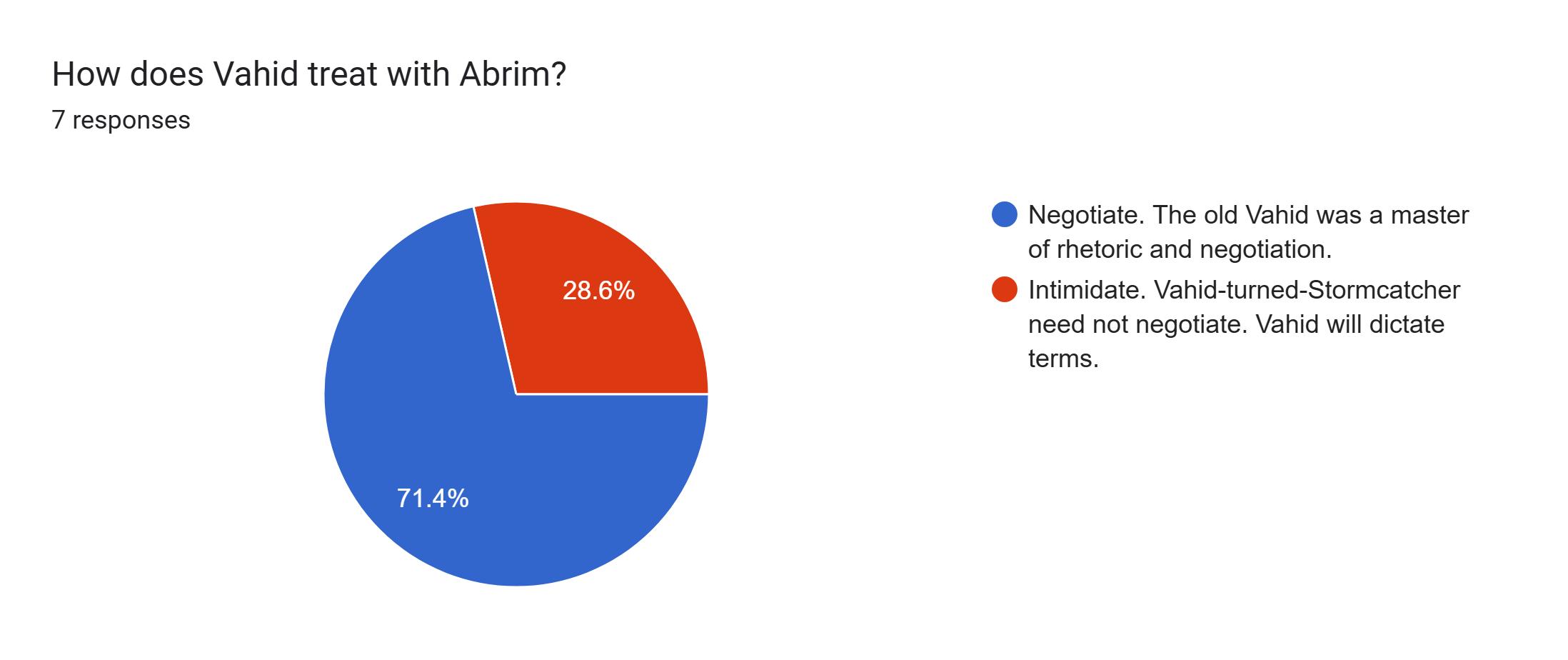
The reader poll asked whether Vahid would negotiate or intimidate. Let’s see what you chose:
Vahid’s hubris does not get the better of him this time: He chooses to be a mere man, and negotiate with the Judge-Priest.
Scene 5: The Delve’s Ruins, cont’d
The whispers of the storm-spirit press against the walls of Vahid’s mind, urging him to answer Abrim’s challenge with ruin. A word, a gesture, and the storm would answer — these gaunt survivors and the zealot who commands them scattered like chaff.
No.
Vahid closes his eye. For a moment, the amphitheater falls away — the mob, the gibbets, the smell of dust and unwashed bodies — and he is in the Lycaeum’s hall, facing a row of examiners. An old master’s voice, stern and patient, echoes down the years: Grasp the matter, and the words will follow. And the matter, always, was the man across from you — what he feared, what he hoped for. An orator who did not know the shape of another man’s heart could only bluster.
He opens his eye and looks at Abrim, thin and wild-eyed. This man is not my enemy. He is a shepherd who fears he will lose another flock.
“You are right, Abrim,” Vahid says quietly. The crowd stills, straining to hear him. “I owe your people a debt. Not the debt you have named — I swore no oaths to the Delve, and the men and women who chose freely to seek refuge in Stonetop are not mine to return to you. But I counseled you to take up the Lawkeeper’s mantle, and then I was not here when the fire came. That debt I will pay.”
At these words, the crowd’s murmur seems to ebb a bit, and Vahid looks over their gaunt faces. “But my people have committed no crime, and they must be released.”
“They trespassed upon our land. Felled our trees.”
“Hubris,” Vahid says, pitching his voice to carry over the crowd, though he speaks only to the Judge. “Ungodly hubris. Are you Danu herself, that you claim the very trees—growing things that you neither sowed nor tended?”
A ripple passes through the crowd — shock, or anger, or both. Abrim’s face darkens. “You dare speak to me of hubris, Stormcatcher? You, who—”
“I dare because you are a Judge of Aratis, Abrim, not a lawless warlord. If you mean to rule by the law, then rule by it. My people came to fell timber in the Foothills, as Stonefolk have done since before your grandmothers’ grandmothers were born. The Delve cannot claim what belongs to all. You must release our people, with what they have gathered. In return, I will remain here, and settle things between us.”
“You will remain,” Abrim repeats, flatly.
“I will. And I will do more than remain.” Vahid lets the Azure Hand rest against the flagstones, and allows a faint pulse of light to travel its length — not a threat, but a reminder. “You need food, Abrim. Not the scraps I can beg from Stonetop’s stores, which are nearly as lean as yours. You need a harvest. I cannot promise you one. But I have power enough to better your chances, if you will let me try.”
The Judge studies him. The branded men on the steps are still. In the gallery, a child fusses and is hushed.
“What power?”
“I command the winds and rain, Abrim. I can bring them here, and perhaps make life spring from this harsh stone, if your folk are willing to tend the land. The Delvers cannot eat justice, nor vengeance. Let my people go, and let me work."
Abrim gestures to the assembled crowd. “Look upon those you left behind, Vahid. They are weak with hunger. By the time harvest comes, there will be none alive to reap it.”
“Then you must trade. When my people return home, send them with whatever iron remains in the town, or what you can bring up from the delves. Stonetop will respond in kind — freely given in fellowship, not demanded as a ransom.”
Vahid is triggering Persuade here, using his Let’s Make a Deal1 moveto make this as much of a sure thing as possible — but he’ll have to stay in the Delve while he delivers on his promise.
Vahid triggers Persuade: 5+5+1 Charisma = 11, Strong Hit
No problem here. Abrim assents.
Abrim's hand goes to the chains around his neck — the old habit of a man who once wore them as bonds, not ornament. He grips them, and Vahid sees the knuckles whiten. The assembly is utterly silent as they await his words.
Finally, he speaks. “Very well. We accept your offer of service. Your people will be released at first light. The timber and iron goes with them.” He raises a hand before Vahid can speak. “But you will answer to the law while you are here. Aratis' law. You will eat what we eat. You will sleep in the commons. And if your power fails, or if you flee in the night, there will be no second mercy. So must it be.”
The crowd murmurs their assent to the ruling, though Vahid can hear the edge of anger and vindictiveness, waiting to be unleashed. He expects to feel afraid, but his heart beats steadily, driven by the vis of the storm spirit bound into his flesh. He can inflict no punishment on me without my leave. The thought comes unbidden to his mind, and just as quickly, he marshals his counter-arguments against it. This is not so — this band of desperate men could trouble Stonetop, and through my home, me. I am not above these matters.
‘Yet,’ comes the answer from deep within.
Setting the Scene: Vahid makes a plan
We’ll break the scene here and talk about what’s happening mechanically. Vahid has just promised to help the Delvers grow food using the power of the Azure Hand. The question a player might bring to their GM here is: I want to control the weather over this valley for a season — bring rain when they need it, hold off the frost, give these people a chance at a harvest. Is there a way to do that?
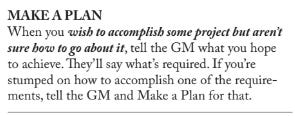
This is a great opportunity to use one of Stonetop’s culture-of-play principles, a ‘move’ called Make a Plan:
Source: Stonetop // Jeremy Strandberg
I love this move for how it guides players towards collaborative play with the GM. It can be tempting, as a GM, to force players to figure things out for themselves, or to provide bare-bones information and make them grope in the dark. But often that doesn’t make for interesting, fast-moving stories — it makes the game feel crunchy, like we’re players trying stuff rather than characters doing stuff. Make a Plan invites the player to name what they want to accomplish, and then the GM helps them find the path — including the costs.
So, the path: The Azure Hand has an ability called Resonance, which allows the Seeker to capture a powerful source of elemental energy — a late spring storm, say — and use it to shape the weather around a settlement for a season. Mechanically, the settlement gains advantage on their Seasons Change roll. That’s exactly what Vahid needs to give the Delvers a fighting chance.
The problem is that Vahid doesn’t currently have Resonance unlocked. But there’s a Seeker move called Improvise that allows the Seeker to reach for abilities of his arcana he doesn’t normally have access to. Vahid doesn’t have Improvise either — and we’re not really at a point where he can level up. So, the question becomes: can I trade one of my existing Seeker moves for another?
This is not uncommon in PbtA games. Sometimes a move just isn’t pulling its weight in the fiction anymore, or was important to the early character but has been left behind as they’ve grown. Often you can make the swap quietly, without even acknowledging it in the story.
But other times, the swap is the story.
Vahid is reaching for the power of Stormcatcher, and we’ve already established that he’s losing elements of his former self as he embodies Indrasduthir, the ancient Maker sorcerer. So we need a move to give up — one whose loss will cost him something the reader can feel. Searching his character sheet, I settled on Polyglot. Vahid has long been the group’s interpreter, and this move gave him fluency in any living language the fiction called for. He also has the advanced version, Cryptologist, which allows him to read arcane runes, dead languages, and ciphers.
Here’s what the swap looks like in the fiction: as Vahid meditates on the Azure Hand’s power over the weeks to come, consulting the memories of Stormcatcher that now live inside his head, he loses his command of living tongues — but retains the ancient ones. He’ll still speak the Stonetongue; it’s what he speaks the most right now, the language of daily use. But Steptongue, the trade pidgin of the Hillfolk and the Delve, will slip away from him. And Lygosi — the language of the city where he was born, the tongue his mother spoke to him as a child — will go with it.
That’s the cost of the deal he’s making with Abrim: a piece of who he was, making room for what he is becoming.
But before any of that can happen, Vahid has to reach into Stormcatcher’s memories and find the knowledge he needs. For that, we have the custom move we wrote when Vahid ‘died’ and lost some part of himself through the Last Door:
When you try to recall memories of your past life, roll +WIS: on a 10+, you remember clearly. If you act on information in the memory, or share it with someone to influence them, gain advantage on your next roll. On a 7-9 choose 1:
Your memory is cloudy or fragmentary.
You remember nothing of what you are trying to recall, but instead memory of your spirit-life. It may or may not have anything to do with what you were trying to remember.
Your memory is clear, but deeply colored by the perspective of your spirit-self.
Now, I didn’t quite intend this when I wrote the move, but it does say “your past life” in the trigger text, and we have fictionally established that Vahid’s “past life” includes that of Indrasduthir, Stormcatcher, master sorceress and creator of the Azure Hand. Vahid now triggers the move not to remember his childhood in Lygos, but his life as one of the ancients.
Vahid triggers Recall Memories: 4+5+1 Wisdom = 10, Strong Hit.
Hot dice for Vahid. He remembers clearly — the knowledge of Resonance is there, whole and waiting, inherited from a being who shaped the weather over whole kingdoms. The path is open. Now we watch him walk it, from a distance, as the weeks pass and the season turns. We’ll zoom out from scene play into a homefront montage, while Vahid bends the Azure Hand to his will.
Montage: Vahid in the Depths
Abrim sends two branded men to escort Vahid into the depths beneath the burnt-out ruins of the upper tenements — the tunnels and chambers that were once Odo’s domain, carved out of the Forge Lords’ abandoned underhalls. The guards carry torches and keep their hatchets in hand. Twice, on that first descent, Vahid hears skittering claws in the dark beyond the torchlight, and a low sound that might be breathing, but if any of Odo’s twisted flock yet survive, they do not show themselves.
The Forge Lord archive where Odo made his sanctum is as they left it — a long, vaulted chamber on the lowest level, its walls lined with orderly niches cut with ancient precision into the living rock, each holding thin, rolled sheets of bronze iron, inscribed in the dense, sharp script of the Forge Lords. Many are damaged — cracked, corroded, defaced by Odo’s people or simply by the passage of millennia. But many still remain — a trove of knowledge that Vahid has only scratched the surface of. The last time the Seeker was here, searching for a cure to the Howling Curse, he labored for hours to decipher them.
Now he reads them as easily as a man reads his own name. Indrasduthir sojourned among all the great Maker clans — the Green Lords in the great woods, the Stone Lords on the grasslands, and here, with the Forge Lords of the mountains. Now that her storm-spirit is bound to him, he remembers it as though it was he who walked these halls a millennium ago.
He returns to the archive each day, descending at dawn and emerging at dusk, his guards rotating in shifts at the chamber door. Much of what is described here is astonishing — alchemical methods describing the shaping of unbreakable Makerglass, schema for an artifice that draws salt from seawater, a treatise on a dream-realm that can be entered through meditative practices. After a few days spent paging through wonders, Vahid cannot help but laugh. All of it, useless to starving folk.
After a week spent in guttering torchlight, he finds a familiar scroll — hammered onto bronze as thin as paper, written in a hand and voice that feels like his own. He runs his fingers over tablets describing the weather patterns of the valley — the cold air that pools on the Foundry floor each night, the frost that creeps up from the valley bottom, the narrow window of growing season that the Forge Lords fought against with their terraces and thermal stonework — and he does not need to parse the script.
He remembers flying high above the valley, feeling the flow of the wind and vapors, dictating notes to an attentive scribe-tulpa. He remembers the arguments with the builders about where to cut the irrigation channels to capture the clouds’ bounty.
Another week passes. Vahid eats what the Delvers eat — thin porridge, whatever the foragers bring in from the hills, rock crickets caught in the caves, and the last of the dried stores from before the town’s burning. He sleeps in the commons as Abrim demanded, on a pallet of salvaged cloth, the Azure Hand cradled in his arms. Some nights, the Delvers watch him from the edges of the firelight. Some nights, the children creep close to stare at his glowing eye. He does not mind. His mind is in the deep places, with the tablets and the memories.
One evening, a guard asks him something in the Marchsprech as they climb the stairs from the library. The guttural tones are harsh in Vahid’s ear, and the meaning of them slips through his fingers like sand. Vahid opens his mouth to answer, and words do not come. He answers in the Stonetongue instead, and the guard’s face creases with confusion. Vahid waves him off and returns to work.
At his instruction, growing beds on the third and fourth terraces are excavated down to the Forge Lords’ original stonework. Beneath the ash and rubble of the burned tenements, the ancient terraces are layered as the Makers built them — gravel and sand over fitted stone, designed to drain and hold moisture in equal measure. The soil that remains is thin and poor, but the ash of the burning has given it something back, and what little the Delvers have — seed-grain, a few withered tubers pulled from a ruined storehouse, herbs gone half to seed — goes into the ground.
It is not much. But it is in the ground, and now Vahid can do his part. As the Delvers finish their hurried planting, Vahid ascends into the sky and goes hunting for a storm.
He finds one building over the peaks to the north — a late spring squall, heavy with rain, dragging a dark curtain across the mountain peaks. To Vahid’s storm-touched sight, it is a living thing — a knot of elemental vis, wind and water and cold bound together in an intricate pattern.
He flies into it. The wind tears at his robes and the rain drives against his skin like gravel, but the Azure Hand sings in his grip, drinking in the storm’s power. I was made for this.
Because of Vahid’s strong hit on the Recall move above, he has advantage for the roll to capture the storm in the Azure Hand.
Vahid triggers Improvise w/ Advantage: 5+4+1+2 INT = 11, Strong Hit
He raises the staff into the heart of the squall, and Vahid feels the power settle into the staff like water filling a bottomless vessel, and the storm falters around him — the rain thins, the wind drops, the lightning dims. Once it falls silent, captured fully in his grasp, Vahid descends back toward the valley.
He releases it above the Delve — not as a tempest, but as a tamed beast, bound to serve the valley. The vis settles over the terraces like an unseen bower, and the weather begins to change. Rain comes when the soil is dry — not deluges, but steady soakings that let the thin earth drink its fill. On the nights when cold air pools in the valley bottom and frost threatens the fragile shoots, the Delve stays warm, heated by gusts from the flatlands. The morning fogs that would have robbed the seedlings of precious sun disperse before the dew has dried.
The Delvers do not understand what Vahid has done — but they know that the sky has bent to his will. Every night in the commons, Vahid sleeps at the center of a quiet, reverent circle of Delvers. Someone leaves a bowl of porridge and a garland woven of mountain flowers by his head every morning before he wakes. The branded men guard him day and night.
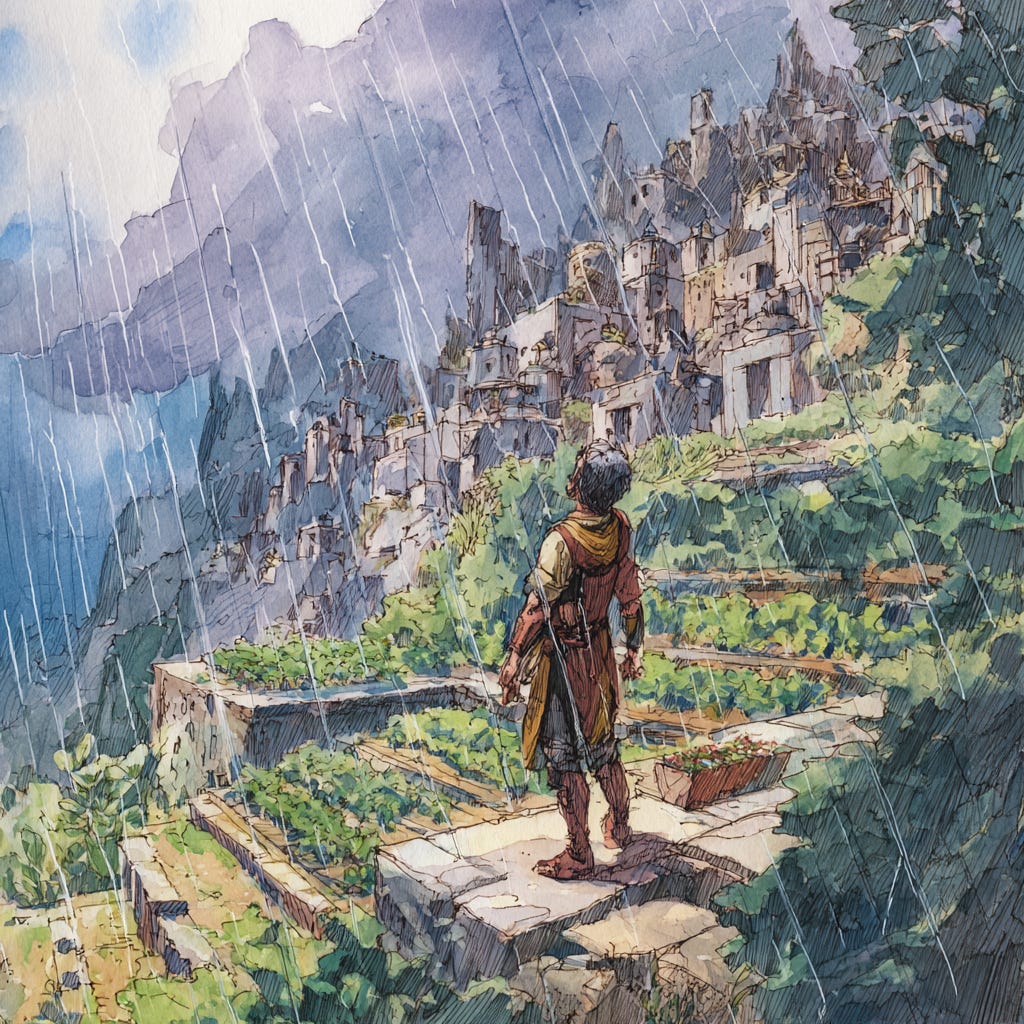
Spring rain falls on the Delve. // Source: Midjourney
At the end of the fourth week, he meets with Abrim on the fourth terrace, overlooking the new plantings. The barest shoots of green have just begun to pierce the soil.
“I must take my leave, Abrim. I have made promises to Stonetop that I must keep. Is my debt to your temple fulfilled?”
The Judge is silent for a time. “What will you do, if you defeat this sorcerer, Vahid?”
Vahid feels a twinge of impatience. I need not explain myself to you. “The sorcerer is a great challenge, yet. I cannot see my path beyond him.”
Abrim laughs bitterly. “Think on it well, Seeker. For the power you have shown here, some men will think you a god. Others, a devil. Between the two, you will not know peace this side of the Last Door.”
Vahid smiles. I have already stood before the Last Door, and I turned away. Whatever peace waits beyond it will wait a while longer. “I will think on it, Abrim. Keep your temple well. I will return next season to pay my debt again.”
The Judge makes no reply as Vahid rises into the heavens again, flying west, towards Stonetop.
We’ll close out the episode there — I have some notes on the happenings back at Stonetop, but they didn’t quite meld well with what’s here to create a tight episode, so this one will remain a Vahid special. Thanks as always for reading, and I’ll see you in your inbox next week, to check back in with Anwen, Padrig and Mado back at Stonetop as Spring draws to a close.
It’s been a while since we triggered Let’s Make a Deal, so here’s a refresher: It triggers when Vahid persuades someone with something they want, rather than by making some sort of argument or plea. Abrim wants to feed his people, and Vahid is offering a chance at that.