
Session 16.6: Binding
Padrig offers his hand, Anwen keeps watch, the village feasts
Last episode was another on the homefront. The village is Diminished — exhausted from weeks of hard work on the wall, the smithy, and the fields — and Padrig went looking for help in getting them back on their feet. Judge Garet sent him to Cerys, and Cerys turned the conversation from village morale into something far more personal: a marriage. Padrig’s marriage, specifically, to Heledd — the widow of Royce, the man whose death Padrig’s kinstrife helped cause two winters past. His go-between in this matter, according to village tradition, must be Pad’s sister, his eldest living female relative.
That’s the business we want to take care of before we roll Seasons Change: Padrig has to walk across the green and ask a woman he barely knows — the girl he left behind when he ran off to be a bandit — to vouch for him as a man worth marrying. If she agrees, the wedding clears Diminished and gives us a Fortunes bump before the Seasons Change roll.
We’ll pick up where we left off — Pad’s got work to do:
Scene 7: Stonetop’s southern slopes
That night, Padrig sleeps poorly, or not at all — the hours after he left Cerys’s House of Healing were spent on his pallet in the Companion’s hall, staring at the low rafters, listening to Hartig1’s thin, wheezy breathing three beds down.
The next day, after the work is done, he heads south. The southern end of the village is herder’s country — low stone houses built against the hillside, their turf roofs greening with the late spring, penned enclosures where the does and ewes, and their kids and lambs are brought in as the light fails. Padrig grew up among these houses, and the smell of lanolin and dung and woodsmoke is the smell of his childhood.
The flocks are coming in. He passes Cadwyn’s nephew driving a dozen ewes up the track with a switch, the lambs bleating and stumbling on the muddy path. Further on, old Meirion stands at his gate, counting his goats through with a practiced eye. When he sees Padrig, he raises a hand to the old bandit, but his eyes are questioning. I have not come back here since I returned. He wonders why now.
He finds her in the shadow of the ringwall. Seren is sitting on a flat stone outside her door, a drop spindle turning slow circles beneath her hand, a basket of carded wool between her feet. Her hair is darker than his, pulled back from her face and tied with a leather cord. She is smaller than he remembers, or perhaps he has simply grown used to standing beside Anwen. A few paces off, her husband—curse you, Pad, what is his name?—is mending a wattle hurdle with another man, one of the neighbors. Their eyes find Padrig as he approaches, and her husband rises before he gets there. He sets down the mending tool without haste and crosses the path, placing himself between Padrig and the flat stone where Seren sits.
“Good day to you, Padrig. Is there something the Marshal needs from us?”
Up close, the man is younger than Padrig expected — younger than Padrig, certainly, with a shepherd’s wind-reddened face and hands thick with callus. He meets Padrig’s eye and holds it.
“No, you and yours are doing all that’s needed and more. I’m about my own business—come to speak with my sister.”
He nods. “Aye. I expect you have.” The man does not move. “It’s been a long day for all of us. She’ll need to go in to see to our girls soon.”
The silence between them stretches. Pad doesn’t want to order the man aside, nor does he wish to plead with him. So instead, he waits.
“Gethin.” Seren’s voice is calm, and carries. “Let him through.”
Seren does not rise. Padrig lowers himself to the ground beside the flat stone, settling cross-legged in the dirt like a boy at his mother’s hearth. The grass is damp and cold through his trousers.
His sister’s hands have not stopped moving. She draws a length of wool from the carded bundle in her lap, pinching and pulling it into a fine, even cloud between her fingers, and gives the spindle a sharp roll against her thigh. It drops, hanging free, turning fast, and the twist races up through the drafted fibers and sets them into thread like a conjurer’s trick. She watches the light of the setting sun and the wheeling dance of the swallows above the fields, not the work. Pad remembers her sitting by their mother’s side, practicing the movements with halting uncertainty. Now, in the golden light, she looks as skilled as Arianrhod, who spun the threads of fate to favor Tor, her sometimes-lover.
“Seren. I am sorry I have not come to speak with you sooner.”
Her eyes meet his while the spindle continues its dance in her hands. She smiles sadly. “I know you are, Pad. I know there are greater matters facing our folk than my weaving and my hearth. I’m glad you’re back.”
“I’ve seen your girls,” he says. “They look hale. Happy.”
Seren nods, her hands still moving. “They are.” A pause. “They’re proud of their uncle Padrig, you know. They see what you and your men do for the village. Elin tells the other children her uncle taught the new Marshal all she knows of battle.” Her eyes dart to the shaded door to her hall, and Pad follows her gaze. There, two dark-haired girls—one nearly a woman, the other just past childhood—watch with dark, curious eyes. Seren gives them a playful hiss, and they vanish inside.
"I owe the village much," he says. "For giving me and my men succor, after — after I came back."
The evening is falling around them. Somewhere behind the house, a goat bleats twice and falls silent. Seren watches the last of the light on the ringwall above them, and Padrig watches his sister’s face, and sees his mother there — the same look on her face when she is not saying what she is thinking. He looks away.
“Why did you leave, Padrig?”
She says it the way she might ask about the weather, or the state of the flock. Her spindle has stopped falling, and now her hands are in the bundle of wool, tearing it off in small, deliberate pieces. He knew she would ask this, and he has thought much on it. He could tell her about the wolf hunt2, all those years ago. About their father's anger, and how it had felt like a door closing. About how he had walked out through the gate the next morning with his bow and his bedroll and nothing else, and how the road had felt like freedom. He could tell her that the freedom became violence, and the violence became a life he could not bring home to her, or to their mother, or to their father. That by the time he wanted to come back, he had done things that made coming back feel impossible.
“I was young,” he finally says. “And I was angry at Da. He wanted a shepherd, and he got a fighter. I wanted to prove I could brave the dangers he thought were too great for me, and I was too proud to come back before I’d made something of myself.” He looks at his hands. “By the time I wanted to, I couldn’t. Too much had happened.”
She nods, and puts the spindle back in motion, rising and falling again. Seren’s husband and his man still watch them from the fenceline. “I’ve heard those stories, too. That you lived a bloody life. That you hurt people, and their kin will come for vengeance one day. Is that so?”
Pad grimaces. “It is. Most that I have wronged are far from here, or dead and buried. But who can say what may come?”
Seren is quiet for a time. The swallows wheel overhead. Somewhere behind the house, one of the girls is singing, a weaver’s song about a girl who became a spider.
“Mam asked for you,” Seren says. “At the end.”
“I know,” he says.
“She wasn't angry. She was frightened for you. She thought you had died far from home, with no one to speak for you when the Lady of Crows came." Stonefolk can think of few things worse — they hurl it as a curse in their bitterest moments: May you die far from home. Pad had sought it out, once.
Seren looks at him. "I told her you were alive. I didn't know if it was true. But you were always so quick, so clever, so sure, I knew that whatever befell you out there, you’d find a way through.” She allows herself a small, prideful smile.
Pad thinks of his many near misses — arrows he felt the wind of as they passed, scars over not-quite-vital spots in his flesh. Luck, more than anything, seems to have kept him from the Lady’s cool embrace.
The swallows have gone. The dark sky above the ringwall is deepening, and the first bats are out, fluttering in search of prey. Gethin has not moved from the fenceline.
“I have no right to ask you for anything,” Padrig says. “I know that.”
“But you’re going to ask me something all the same.”
“Aye.” He picks at the grass beside his knee. “Cerys believes — and I think she’s right — that the village needs something to hold onto. Something that isn’t the coming battles. She wants me to marry. Heledd, Royce’s widow.” He pauses. “I need a kinswoman to go to her household and speak for me. To say that I’m a worthy match for her.”
The spindle stops.
Seren looks at him for a long time. The light is almost gone now, and her face is half in shadow, and for a moment she looks so much like their mother that Padrig has to look away.
“Do you want to marry her, Pad? Or is this Cerys, putting you in your proper place?”
“Cerys counseled me,” he says. “But this is my choice. I want it because —” He stops. Starts again. “I want to put right what I have done wrong. I cannot undo my bloody years on the road, but I can do right by our ways, and by Heledd. She is a good woman who deserves better than what happened to Royce. If I am to stay here, I cannot leave these wounds untended.”
“And that’s what you intend to do? To stay here, with us? For the rest of your days?”
For however long that might be. “With the dangers that face our village, I do not know how many days I have left. I will stand by Anwen’s side, and without fail, she goes where the fighting is thickest,” he says ruefully. “If Heledd were to have me, belike she’d be twice a widow before long. But until then, I’ll do right by her. And her daughters.”
Seren picks up the spindle again. She winds the finished thread onto the shaft, slow and deliberate, and nestles it with the unused wool in her basket.
“I’ll go to her in the morning,” she says. “Why don’t you take your supper with us? Can your duties spare you one night?”
A cool breeze brushes against Padrig’s face, and he can feel a soft mist gathering in his eyes. One brush of his hand, and it is gone again. “Aye, I’d like that.”
Together they rise, and joined by her husband, they go into the warmth of Seren’s hall.
A simple scene, no rolls involved — I considered having Padrig trigger Persuade, but in the end decided against it: His sister wants him to stay, and is not a reluctant participant. Once he made his case, she was ready to say yes.
Next, we’ll check in with Anwen and Mado — this is a scene set by the Keep Company move, exploring the question “who or what seems to be on your mind?” between those two characters. Mado began this session with a serious decision: He chose to lie to his mother, Cerys, the village priestess, and concealed the worrisome influence of Stormcatcher, the ancient, long-dead Maker sorcerer on their companion Vahid. No doubt this preys on his mind as the village prepares for war.
Scene 8: Atop the Old Wall
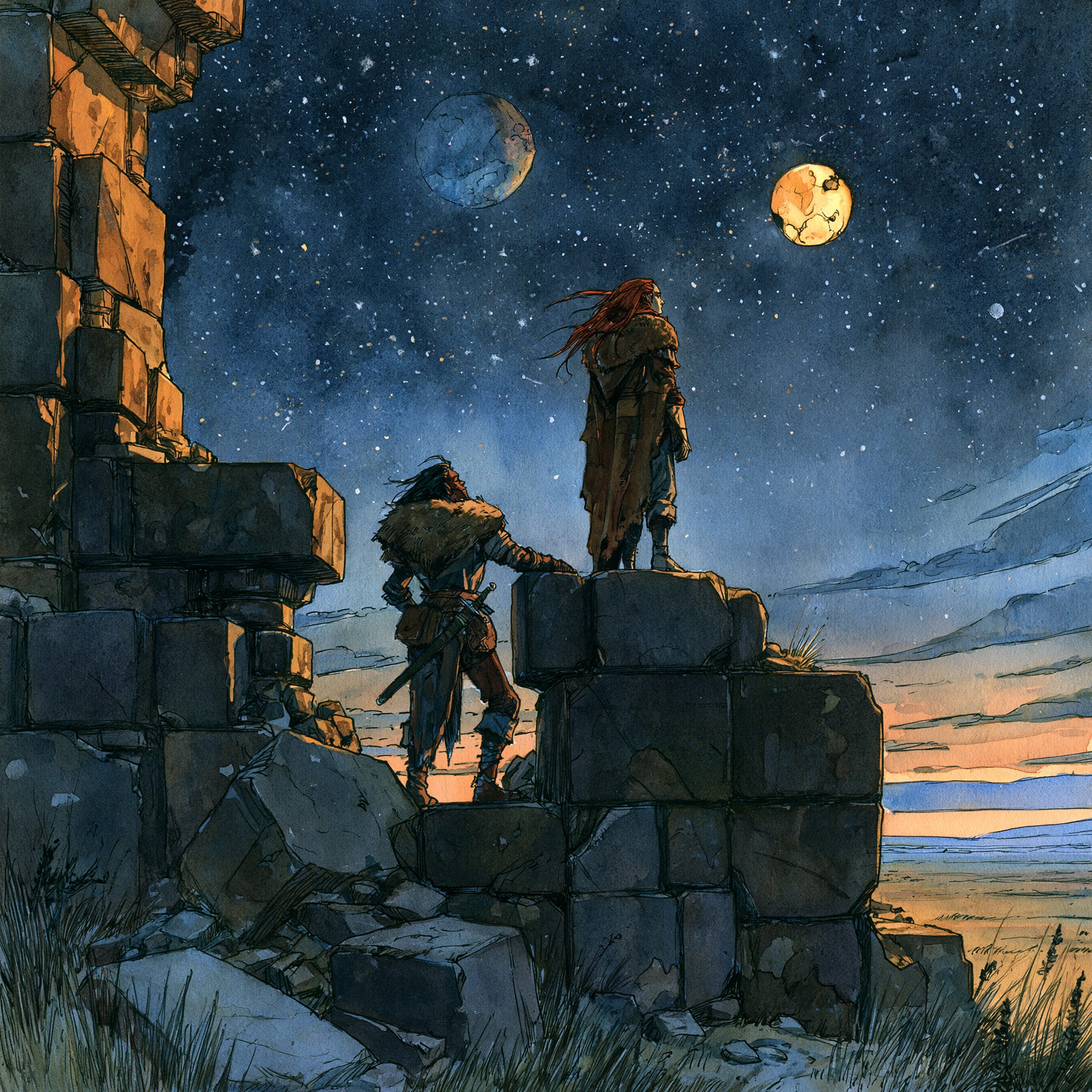
The wall is quiet after dark. Towards the village, Anwen sees torches in the watchtowers burning low — Padrig’s standing order, so the sentries can see outward without blinding themselves — and the night watch moves in pairs along the southern face of the Old Wall, where the Flats stretch out into a vast, empty expanse of sky. When they’d begun keeping watch, a month ago, making a circuit around the village atop the Maker’s cyclopean stones had been easy, with only a few broken sections to navigate. Now, the ancient structure is full of ragged holes, and the ringwall around the village stands proudly at twice a man’s height.
She walks the wall most nights now. She, like many of the village’s leading lights, finds sleep elusive. When the wind stirs at night, and thunder rumbles across the Flats, she feels the markings awakening in her arms, and when she does sleep, she dreams of racing across the plains, blades of grass a thousandfold whipping at her limbs, the wind carrying her more swiftly than the fastest steed.
Tonight, Tall Talfryn walks beside her. He is good company for this work — long-legged, quiet, watchful. He has recovered from the training bout when she broke his shield and laid him flat, and now Mado tells Anwen that he is one of the village’s best fighters. He talks about the weather, and the state of the barley, and about the comings and goings of old Meirion’s granddaughter, whom Anwen suspects he is sweet on. She is grateful for every word of it.
They are on their second circuit of the night, with the twin moons rising high in the night sky, their blue-silver and golden faces full and bright, when Mado appears on the rocky steps below them. He climbs without hurry, his barrow-blade at his hip, a shaggy tonnerhorn fleece wrapped around his shoulders against the evening chill.
“Talfryn. Get some sleep. I’ll walk with the Marshal awhile.”
Talfryn looks to Anwen. She nods, and the tall man descends without complaint—no doubt eager to find his bed after a day of hard training and a night spent walking their patrol. His footsteps fade on the stone.
Mado settles into Talfryn’s place at her side, and they walk. The Flats are dark and vast beneath them, the grass silvered and gilded where the moons break through the clouds.
For a time, he says nothing. That is one of the things Anwen has come to value about Cerys’s youngest — he learned to keep his own counsel in Jarl Dane’s court, and does not fill silence for the sake of filling it. They make half a circuit before he speaks.
“So, Padrig is to wed.”
Anwen allows herself a small smile. “So it seems. I am glad for him. He’s really coming home.” She pauses. “Cerys got her way, in the end.”
“My mother usually does.” There’s no bitterness in it, just the wry acknowledgment of a man who grew up watching the machine work. “It’ll be good for the village. People need something that isn’t walls and watches.”
“Aye. They do.”
They walk a few paces in silence. Then, quieter: “How are the dreams?”
Anwen glances at him. “How did you know?”
He shrugs. “I didn’t know for certain. But you walk the wall every night, like you are avoiding your bed.” He keeps his eyes on the Flats. “My dreams were troubled after Rannon died, and again after I killed my first man for Jarl Dane.”
She considers denying it. But this is Mado, who has faced many terrors in his life. He has never once looked at her storm-marks with the fear and worry she sees in the other villagers’ eyes.
“I dream of running,” she says. “Faster than anything alive. The wind carries me. It feels —” She stops.
“Good,” Mado finishes. “It feels good.”
“Aye. It does.”
They walk. The wind stirs off the grasslands, and Anwen feels the marks hum faintly along her forearms. She folds her arms into her bearskin cloak.
“Are your dreams troubled, too? By the monster you saw in the barrow?”
Mado is quiet for a few paces. “The Thrice-Betrayer doesn’t trouble me. He’s pinned to his tomb and rotting. He’ll be there long after we’re dust.” He pauses. “It’s what he told us that I can’t put down.”
“Told you? You told your mother the wight didn’t speak.”
“I lied.”
Anwen stops walking. Mado stops with her. In the moonlight, his face is calm, but his words are dire. “The Betrayer called Vahid master3,” Mado says. “It said Stormcatcher, Indrasduthir, whichever of the names you call her, didn’t die when her great tower fell. She broke herself apart — scattered her mind across the storm-spirits that served her. As long as the storms rage on the Flats, some piece of her survives.” He looks at Anwen. “One of those pieces is inside Vahid now. It has been since Gordin’s Delve. It is not only the spirit that has a hold on Vahid’s mind — it is Stormcatcher herself, the ancient.”
Anwen thinks of the night they found the Seeker in the shadow of Stormcatcher’s ruined tower. Vahid’s broken body propped against the stones, speaking of himself as though he were already gone. Vahid is only memories, now4. She had refused to hear it. You are Vahid, she’d told him, and he’d said it back to her, and she let that be enough. Earlier, on the road home from their defeat at Gordin’s Delve, he’d told her plainly that Stonetop no longer felt his home. That no place did. She let that lie, too.
And the promises she’s made — the oath at the Companion’s hearth, during the winter’s kinstrife. And the many since then. Pad and I are with you, Vahid. To whatever end. She’d sworn it freely, before the heat of battle, when whatever end meant death beside a friend. She had not imagined it might mean something like this — something strange and wondrous and terrible.
“Why are you telling me this, Mado? Why did you lie to Cerys?”
“If she thought him to be in the grasp of the ancients, she would act. She’d try to drive him from the village, split us in two with the enemy gathering against us. Maybe she’d be right to — maybe your Seeker is the true threat. But if she's wrong, we lose the only weapon we have against the sorcerer." He pulls the tonnerhorn fleece tighter around his shoulders. "I've watched him. Spoken plainly with him. He saved my life more than once. There's still a man in there. But I don't know how long that lasts."
"You're asking me to watch him."
Mado shakes his head ruefully. “Everyone will watch him. I watch him, my wise mother watches him. Pad watches too, even not knowing the whole truth. What I am asking of you is to be ready. You're the only one who could face him, Anwen. Whatever power the marks gave you, it was drawn from the same well. If the time comes, you're the only one he can’t just sweep aside."
“I’ll watch him,” she says. “But I won’t move against him on a dead betrayer’s word. Even now, he is at the Delve, saving people from starvation. Is that the act of some ancient, cruel sorcerer?”
“No. It is the act of a king. But kings are not always so open-handed.”
Anwen sighs, her heart growing heavy in her chest. On the road home, the Delvers told stories of the night of the battle, when Vahid and Cirl-of-the-Storms dueled in the sky above the town, their bolts of blue-white death harrowing friend and foe alike. I had no choice, Vahid had said afterward. And many times since.
“My first duty is to Stonetop. Vahid swore he would stand with us, and I still trust him. But if he forswears himself and turns his power against us, then I will be free to do what I must.”
“And will you?” Mado presses. “I have turned my blade on a friend before. It is not easy.”
Anwen looks away. “Thank you for the company, Mado. I’ll walk the rest of my watch alone. You’ve given me much to think on.”
Mado looks as though he will press again, but thinks the better of it. He bids her farewell and climbs down the ruins of the Old Wall. In a few moments, he disappears into the night, leaving Anwen alone in the light of the moons.
Another no-roll scene. Not uncommon on the homefront and with Keep Company scenes. Now that Anwen and Mado have had a bit of time in the spotlight, and a chance to compare notes about the danger they may face together, onward to the session’s close, and the Seasons Change roll.
Montage: Spring’s End
The feast begins at dawn.
It is the first day in weeks where no one works the wall, or the smithy, or the fields. The village needs this. Everyone knows it, even the sentries who drew the short lots for the day watch and must content themselves with watching the revelry from the towers.
The morning is given over to preparation. The women of the village have been at work since before first light — great iron cauldrons of stew over open fires, flat barley-bread baking on hot stones, the last of the winter’s salted meat brought out and carved. There is honey, brought from the Great Wood by a few clever hunters, and the smell of it warming in clay pots draws every child in Stonetop to the Pavilion like moths to a flickering flame.
By midday, the games begin. Foot races for the children first, then the young men and women, tearing across the green in bare feet while the village cheers and heckles. Livestock judging — Elder Pryce holding court among the herders, pronouncing on the quality of kids and lambs with a keen trader’s eye. A stone-hauling contest that draws most of Marged’s work gang and half the village’s fighters—the Companions, the warrior’s circle, the Delvers—red-faced and roaring, dragging sledges of stone blocks from the quarry pile to the ringwall. Anwen watches from the edge of the green, arms folded into her cloak. She could haul stone with the best of them, but she does not trust what her storm-marks might do if she tried.
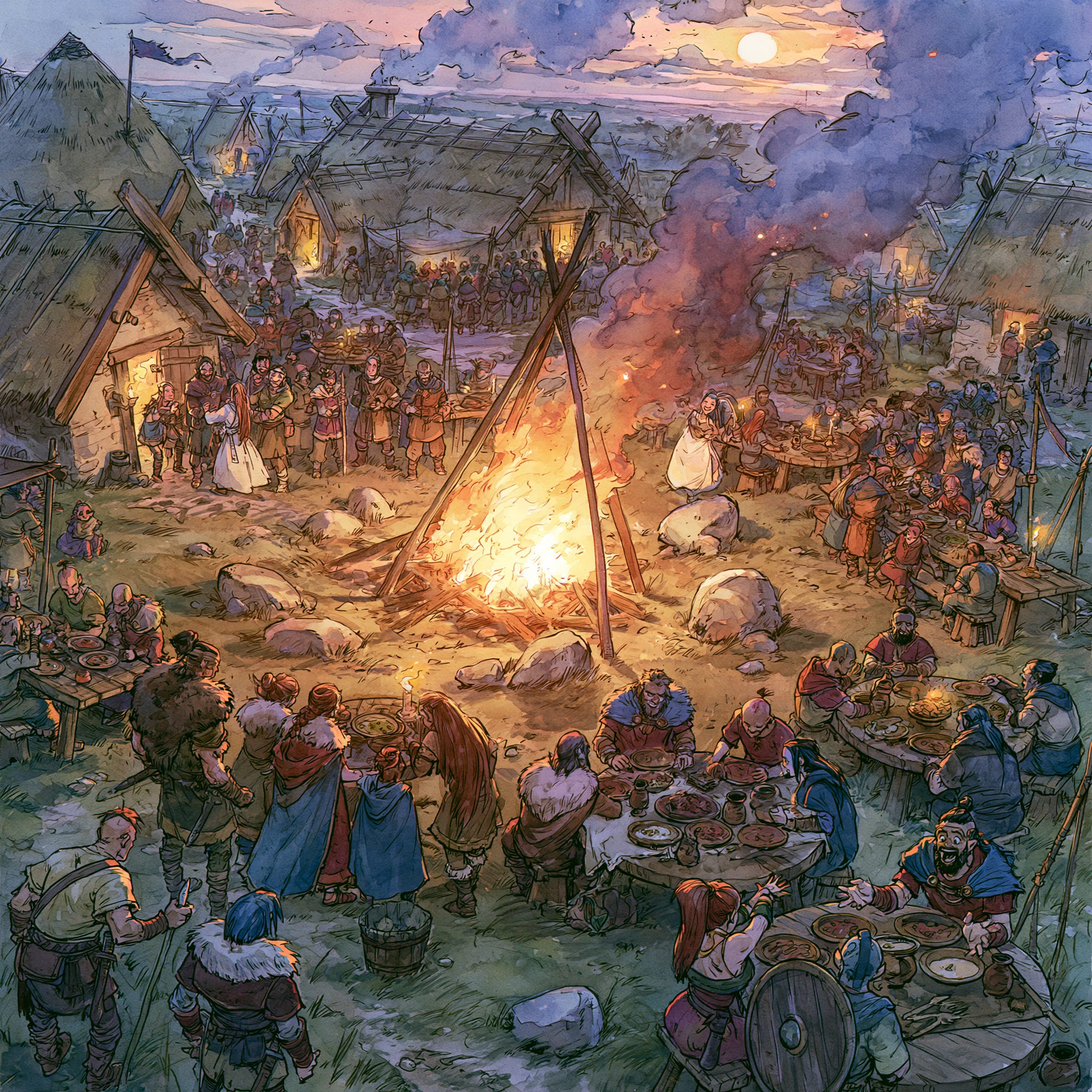
In the late afternoon, as the light turns golden and the shadow of the ringwall stretches across the green, the village gathers at the Pavilion of the Gods for the binding.
Four couples stand before the village. Padrig and Heledd are first — he in a clean tunic that Anwen suspects Seren had a hand in, she with wildflowers braided into her dark hair. Whatever Heledd thinks of the match that Cerys has made for her, she does not show it. She stands beside Padrig with her chin high and her hand steady in his, and when Garet asks if she takes this man freely, her voice carries across the green without a tremor. Padrig’s voice is quieter. Anwen has seen him face a storm-drake with less trepidation in his eyes.
Behind them, Heledd’s eldest daughter stands with young Gerain, the farmer’s son — a match that had been spoken of for months, and which, Anwen now understands, would have fallen apart without Padrig’s marriage to smooth the way. Cerys at work, threading one knot through another until the whole weave holds.
Then Cian, the herder, and Rose, who draws every eye in the village when she smiles, which she does now, openly, beautifully, while plain Cian stands beside her looking as though he expects someone to tell him there has been a mistake. His fellows among the herders watch with a mixture of goodwill and naked envy.
Last, Pad’s warrior, Young Brogan, and Ilse, one of those who escaped Odo’s slave pits. Brogan’s cursed, golden eyes5 are happy at last, and around his neck, as always, hangs the small glass vial of deadly curative that Anwen has never seen him without. Ilse is thin and watchful, with the guarded air of a woman who has suffered much. They do not smile the way Rose and Cian do. But when Garet binds their hands, Ilse’s fingers close around Brogan’s, and she does not let go.
Cerys speaks the blessings: Fruitfulness and warmth, the ever-burning hearthfire, children strong of limb and long of life. Anwen searches her face, and for this moment she can see no sign of the old schemer who has bedeviled them, but only the priestess who has blessed every marriage in Stonetop for forty years. Garet coaxes the couples through the sacred promises—fidelity, provision, and honesty.
Anwen watches it all from the edge of the crowd: The Things Below take Stormcatcher and all her works. This is what we are fighting for.
The feasting runs long into the night. Torches are lit around the green, drums and pipes are given their voices, and then the dancing starts — loose, joyful circles that pull in even the reluctant. Padrig dances with Heledd, then with Seren, then with his nieces, who shriek with delight when he lifts them off their feet. Anwen watches him and thinks she has never seen him so unguarded. Finally, she joins the revel and dances with Rheisart, who’s drunk too much Stonetop whiskey to be bashful when she reaches for his hand.
After a few fast turns around the bonfire, she rests, and finds her eye drawn to Mado, standing apart from the dancers with a cup he is not drinking from. He is watching Blodwen. Rhys’s sister sits near the edge of the firelight, her hands in her lap, a faint smile on her face that does not quite reach her eyes. She has not danced, has not joined the circles, has not done much of anything except watch, the way she has watched since they brought her back from the Great Wood two years ago now. Mado’s face is carefully controlled, but Anwen remembers the message he entrusted to her, the night he and Vahid flew to the Barrow of the Thrice Betrayer: Tell her I thought of her often, while I was gone.
Before the night is through, three more betrothals are spoken over clasped hands, and the village, for one evening, forgets what gathers beyond their walls.
Seasons Change
This is the moment the wedding was building toward. With Diminished cleared and Fortunes bumped back to +0, it’s time to trigger Seasons Change. At the gaming table, this roll is done by whichever PC is most contended. Though he usually doesn’t fit that bill, on this day in particular, Padrig would take that prize, so we can imagine Pad’s player picking up the dice for this one. It’s not a low-stakes roll — a miss here could mean the wedding feast interrupted by Hillfolk war-horns. Let’s play to find out:
Padrig triggers Seasons Change: 5+5+0 Fortunes=10, Strong Hit
The dice have been hot all session! A strong hit on Seasons Change is the best outcome the village could hope for. For Summer, that means two seasonal gains—I choose Unexpected Bounty granting +1 Surplus, because the village always needs it, and especially with all the new mouths from the Delve. For the second gain, we’ll choose Valuable Insight: You learn something that gives you a chance to address a threat that’s been plaguing the village. We’ll get to that in a moment.
In the fiction, this means the rains came when they were needed, the barley is coming in strong, the herds are healthy after a good lambing season, and the stores are holding. Despite the looming threats, the village is starting to feel secure. The wall is rising. The smithy is lit. The people are fed, and they are not afraid — or at least, not as afraid as they were a month ago.
I do some more quick rolls for the surplus gained from Spring — it’s 1d4-1, with a +1 for Vahid’s Raincatching improvement. I rolled a 3, which brings the village’s stores to 5 Surplus, but I also figured I should deduct one for the feast, leaving us with 4.
Now for that Valuable Insight — I think I know the perfect person to bring that news home.
As the revel continues into the night, Anwen rests alone at the edge of the green. She feels his presence before she sees him. A change in the wind, a queer feeling in the air, like a summer storm is coming. The marks on her arms stir, humming faintly beneath her sleeves. She stands.
He comes from the south, riding the wind like a tamed beast. He descends through the moonlight in a slow, controlled arc, the Azure Hand burning steady blue-white in his grip, his tattered cloak streaming behind him like a banner. The air around him crackles faintly, and the grass on the green bends outward from where he touches gently down.
Vahid straightens. He plants the staff and surveys the evening revelry, his face impassive. The lightning-scars have spread since she saw him last — they climb his throat now, branching to the crown of his shorn head—but they bleed no longer. His blue eye is clear and calm.
Anwen crosses the green to him. “Vahid. It’s good to see you. How fares the Delve?”
“Anwen.” He inclines his head. “They will endure. Abrim and I have come to terms. His people will plant, and I have given them rain.”
‘I have given them rain.’ Mado is right, he sounds like a king. “I am glad. And glad to have you home,” she says. “Will you join the feast?”
“No.” The Azure Hand dims to a faint glow, and for a moment he looks tired — merely human. “I have learned much of our enemy’s schemes. We must speak.”
Above them, the moons hang low over the Flats, and the revel continues, not knowing what the morning will bring.
And there we’ll leave it. The village feasts, and the Seeker comes home with schemes on his mind. What he has learned, and what it will demand of Stonetop’s first defenders, will have to wait for next session.
This closes Session 16, and our time on the homefront. Thank you, as always, for reading, commenting, voting, and sharing, I appreciate it so much.
As is the ancient custom of our people, I’m taking the rest of May off with the closing of a session. Session 17 begins the second Monday of June, the 8th. See you then!
Hartig is one of Padrig's Companions, the small band of former outlaws who followed him home to Stonetop. The Companions sleep together in a communal hall near the Pavilion — soldiers' quarters, essentially, for men who don't have households of their own
This calls all the way back to Session 1.1 (our first Keep Company move!), where Padrig told Anwen the story of his coming-of-age challenge. It always feels nice to pay off this kind of long-standing established character detail in lengthy campaigns.
Vahid's words after the Pale Hunter killed him at the Ruined Tower, in Session 15.3. The spirit inside him dragged him back from death, but what returned was uncertain. Mado pressed him on it afterward: "Do you even remember?" Vahid could only recall warmth and fragments — "It is like I have just woken from a dream."
Brogan is one of the Delvers who carries the Howling Curse: A supernatural affliction from time with Odo Thriceborn’s gang. The golden eyes are its visible mark. The vial around his neck contains an elixir that would cure the curse but might kill him in the process.
Lovely home front developments. It anchors all the action and high stakes in real lives lived.
I hope you get some new readers coming from the Quinn's Quest (https://youtu.be/wH5-uQj4uOA) review, where he also emphasizes the village life and the community as the thing that makes Stonetop so much more than Dungeons & Dragons.
May is for gathering flowers...alas Stonetop must plot war....we will see when the season turns!