
🗳️ GM Planning: Session 17
Love Letters, and Vahid, where have you been?
As always with these planning episodes, we’re going into the weeds of the rules and the prep behind the curtain. If you’re here purely for the fiction, there’s not much here for you today, plus some minor spoilers about what you’ll see when the next episode drops on June 8. If you’re caught up and want to talk about gamemaster craft, read on.
Where we left off
We closed Session 16.6 with a strong hit on the Seasons Change roll, which granted us two seasonal boons, and we chose Surplus (of course — we’ve got a village to feed!) and Valuable Insight, which the Stonetop rules describe thusly: “You learn something that gives you a chance to address a threat that’s been plaguing the steading.” There’s only one threat of note plaguing the steading right now, which is, of course, the nomad sorcerer Cirl-of-the-Storms.
In most cases, this valuable insight is delivered by an NPC — we might’ve had a rider from the Sun-Spear arrive during the wedding, bringing news of Cirl’s movements. But since Vahid was absent, and we needed to return him to Stonetop and his allies, I opted instead to deliver that insight through Vahid:
Anwen crosses the green to him. “Vahid. It’s good to see you. How fares the Delve?”
“Anwen.” He inclines his head. “They will endure. Abrim and I have come to terms. His people will plant, and I have given them rain.”
‘I have given them rain.’ Mado is right, he sounds like a king. “I am glad. And glad to have you home,” she says. “Will you join the feast?”
“No.” The Azure Hand dims to a faint glow, and for a moment he looks tired — merely human. “I have learned much of our enemy’s schemes. We must speak.”
Above them, the moons hang low over the Flats, and the revel continues, not knowing what the morning will bring.
So, before Vahid can share his insight, we need to envision where he went and how he learned what he learned.
Making up for lost time
At the gaming table, when a character (and their player) is absent for a time, there’s often a need for a tool or technique to quickly imagine where they were and what happened while they were there. Maybe a player missed a few sessions, and to cover their absence, the party envisioned they fell behind and have to figure out a daring solution to rejoin their comrades. Maybe they were dragged off in the night by kobolds, and have effected a harrowing escape. Or maybe, as in our story, the character went off on their own business and rejoined the party at its conclusion.
A clumsy way to fill that gap is for the GM to simply narrate it: here’s where Vahid went, nothing really significant happened, now he’s back. But there are other options available: Maybe when the character rejoins the party, they arrive with needed resources or allies. Perhaps when they escaped from the kobold’s livestock pens, they stole a key to the dragon-priest’s inner sanctum.
But of course, you don’t want to envision and narrate all that in detail for a single player character, especially if the story demands that the action move on. But if you’re going to provide some benefit to the party, it also makes sense to create some risk — maybe even picking up the dice and making a roll.
Love Letters
Enter: The Love Letter. An elegant tool, first formalized and popularized by Vincent and Meguey Baker in Apocalypse World, which compresses a series of events for an absent player, calls for a roll of the dice, and allows for some player agency.
Here’s how the Bakers introduces them in Apocalypse World 2E:
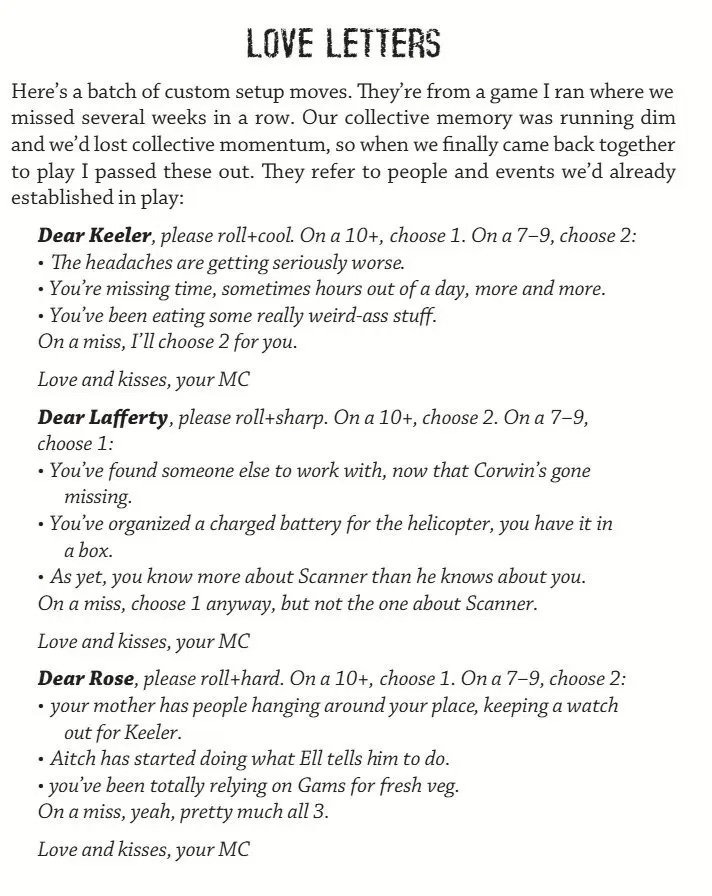
You can see a few different shapes of Love Letters here. In Dear Keeler, we see a player-character’s personal woes: This Keeler fellow is clearly working through some issues, and the MC (the Apocalypse World GM title) is allowing them to pick their poison.
By contrast, Dear Lafferty is about opportunities: this player character seems to have a number of irons in the fire, and the MC is offering them an opportunity to advance on one or more of those fronts. Even on a Miss, Lafferty gets something, but it stipulates that Scanner—who no doubt bears some ill intentions—knows something dangerous about him.
Finally, Dear Rose is more in the vein of Keeler’s letter, but rather than internalized problems, these are externalized ones: All of Rose’s options are about problems NPCs are creating or could create for her. Most likely, Rose is a character who manages a steading or a warband, whose standard mode of operation involves overseeing NPCs and their collisions with one another and her fellow PCs.
The thing all three of these letters have in common is propulsion: No matter what the PC picks, when we get back into game, there’s stuff for them to do. Keeler has new symptoms to manage, Lafferty has an opportunity to advance one of his projects, and Rose has people problems to deal with. The MC can easily set an opening scene for the session by asking the players: So, what do you do now?
In the Stonetop rules, there are some further refinements of the Love Letter technique — one of the best things about those books is the incredible volume of useful, thoughful, gamemastering tech. Here’s how Strandberg lays it out:
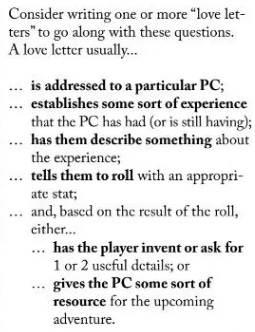
Good GM advice, which the book is chock-full of — if you want more of it, you can order Stonetop here, now that it’s officially released.
Vahid’s Vision
So, we need to ‘establish some sort of experience’ the PC has had. We know what Vahid wants: insight into his enemy. What we don’t yet know is how Vahid gets that insight — and figuring that out will tell us what experience to envision.
The most obvious option Vahid has is to command the wind and take to the skies to scout — range out over the Flats, hunting for a band of Hillfolk to follow to Cirl’s camp or to ask for intel. But it’s a poor bet. He doesn’t know where to begin, so he’d be reduced to patrolling open country on the chance of spotting the enemy first.
At the gaming table, this would be a good time to use the Make a Plan move. In a session, this is the PC and the GM thinking out loud together — the player floating options, the GM envisioning what each would require to attempt, and what risk or cost might be incurred, until a course of action takes shape that’s worth committing to.
As I thought about it, one option from Vahid’s past suggested itself immediately. Back in Session 7, the Hillfolk spirit-talker Katrin led him to a ritual site high in the Huffel Peaks known as the Titan’s Rest. A cave made from the buried head of a giant of the elder days. Within, strange mushrooms grow that, when consumed, grant visions of the fate-tree, revealing the past, present, and future of those with powerful destinies. It was at the Titan’s Rest that Vahid first learned the hdour's history: how a frightened spirit-talker named Cirl struck a bargain with a dying storm and, in so doing, became the man who now threatens everything the party has sworn to protect.

So, if we envision Vahid making this trek to receive a vision, we also have to envision the risk he’s taking. Last time, Vahid had Katrin beside him — the Sun-Spear spirit-talker prepared the fungus, measured his dose, and kept watch over his body while his mind sank into the vision. Her voice followed him down, steadying him against the cold and the regret, until the trance took him beyond her reach. This time he goes alone.
And Vahid is not the same man who made that first descent. Since then, he has died and been revived by a storm-spirit that now shares his flesh — a spirit that we recently learned also bears the memories and soul of the ancient Maker known as Stormcatcher. Her memories are bleeding into his, her perspective now colors his own. No doubt Vahid’s fate is intertwined with hers as well, which could have unpredictable effects on this vision quest.
So, we’ll need to use this fiction to shape the love letter — Vahid gains insight from the tree, but runs the risk of some sort of ‘bad trip’ which reveals him to Cirl or intensifies his connection with Stormcatcher somehow. Since we’ve also established that Vahid is missing important components of the vision quest (Katrin’s aid and preparation of the substance), we’ll also modify the original Commune with the fate-tree roll from Session 7 by giving Vahid disadvantage.
Let’s take a run at drafting this now, like we would if we were at the gaming table:
Dear Vahid,
While Abrim and his flock toiled in the Delve, making a harvest of the rain you granted them, you slipped away. You told no one where you were going. You flew alone into the Huffel Peaks, to the Titan’s Rest, where Katrin once led you into the dark of a titan’s skull and a vision showed you Cirl-of-the-Storm’s past.
There is no one to guide you this time. But you have walked this path before, and the sorcerer’s war will not wait. You eat the dead god’s flesh and travel to the fate-tree, where histories and destinies wait to be read in the dark water.
The tree shows you your enemy. Roll 2d6 with disadvantage. On a 10+, choose two. On a 7–9, choose one:
a secret way into the sorcerer’s camp
one within his camp who would turn against him
the true shape of his endgame
On a miss, choose one anyway — but Stormcatcher stirs in the dark of your mind, and makes her presence known.
Love and thunder, your GM
And that’s our love letter. It envisions an experience that Vahid had ‘off-camera’ (though we’ll probably put it on-camera for the purposes of this Actual Play), provides the party with a resource for the upcoming adventure, and, like the Apocalypse World examples, provides an immediate jumping-off point for player-character action.
Making the Roll
With the love letter written, we can hand it over to the dice:
Vahid triggers Commune with the Fate-Tree (w/ disadvantage):
5+5+4=9, Weak Hit.
A weak hit. The Seeker climbed down into the dark waters of the fate-tree and came back with a single vision of his enemy. We’ll begin the next session with a flashback—Vahid is telling the others what he learned, but we’ll see it through his eyes in the fiction.
But what DID he learn? That’s going to be up to you. Smash the button below to decide what insight Vahid gains through his communion with the dead titan — a secret path, a traitor in the enemy camp, or Cirl’s true endgame:
When we rejoin the fiction on the 8th, it’ll begin with Vahid’s accounting of his journey to the Titan’s Rest and the vision of your choosing. Thanks as always for reading, and I’ll see you in your inbox next week!