
Salutatio | The Beast of Rome, Chapter 1
ROME, THE UPPER ESQUILINE
Spring, 768 AUC. Early in the reign of Tiberius Julius Caesar Augustus
Bread or piss. Every morning, the smell of one or the other greets Marcus Petronius Cursor from his flat’s narrow window, wafting from the bakers’ ovens in the lower Esquiline, or from the urine collectors in the crowded valley of the Subura below, each making their daily rounds so that bellies might be full and togas white.
Cursor watches from his back window, watered wine cooling in his hand. This view is perhaps the finest thing about his little apartment, perched on a rise of the Cispian slope, with three stories of air beneath his windowsill and the tumbledown, squalid insulae of the Subura slum.
As the dawn’s light begins to creep into the valleys between packed flats crowding the valley floor, Cursor sees them: clad in white togas, a slave or two to mark their status, the middlemen of Rome — equites, like him — hurry to meet their patrons for the daily ritual of salutatio.
Salutatio. The daily grinding of Rome’s great machine—patrons receiving clients, hearing petitions, dispensing favors or refusals. Without it, his father had once said, the gutters of Rome would run with blood within three days. Perhaps. For men in the middle like Cursor, it means being ground down twice before noon: first receiving the petitions of men more desperate than himself, then calling on the villa of a man who might not remember his name.
Salutatio. The daily grinding of Rome’s great machine—patrons receiving clients, hearing petitions, dispensing favors or refusals. Without it, his father had once said, the gutters of Rome would run with blood within three days.
Behind him, Tiro clears his throat. “Your toga is ready, dominus. It patched up quite nicely, if I do say so myself.” Cursor turns and regards the old Greek. Wiry and knob-kneed, with only a thin ring of wispy grey hair, Tiro served his father, and now ostensibly serves him, while the old paterfamilias wastes away in a bed in Umbria1. “A little haste will serve us well here. It is good show to keep your clients waiting for a time, but not your patron.”
“Of course, Tiro,” Cursor mutters. “How many, today?” He dutifully presents himself to be dressed. Tiro circles, enrapping him in the stifling white wool.
“Only six,” Tiro says quietly, as though they can hear him from the receiving room. He ticks them off on his long fingers: “A few from back home in Umbria: Lucius Petronius Auctus, your father’s freedman. Most respectful he continues to salute you every morning, make sure you greet him warmly. And Gnaeus Vestricius — he remains hopeful that your introductions will yield scribe’s work.” Tiro’s thin smile shows how likely he thinks that is.
Tiro frowns, his wiry grey eyebrows knitting together in concentration. Gods be gentle to the man, he’s not a nomenclator2. But even so, he should be able to remember a half-dozen clients. Cursor takes another sip of wine as Tiro collects his thoughts. The wine, at least, is decent — a recent vintage from the family villa in Umbria, ably managed by the heir apparent, his eldest brother Gaius. But Tiro’s hand was heavy on the water this morning, and the poor grapes are drowning.
Tiro’s silence stretches. Cursor puts the wine aside and waves his hand. “Nevermind all the names, Tiro. I’m sure their faces will light your memory. Whom should I greet first?”
“Your Umbrian countrymen, I should think,” he says. “We must look after our provincial brethren, where we can. And then perhaps Philomusus, the coppersmith. He looks concerned.”
A fellow Greek, too, Cursor muses. The thought is unjust—Tiro has been with the family long enough that such loyalties no longer move him.
Tiro tugs at a final fold, then steps back to inspect his work. Whatever he sees satisfies him. “A moment, dominus, to arrange your guests.”
He slips through the curtain. Cursor hears the old man’s voice in the next room—warm now, welcoming, the gracious servant of a gracious house. He takes a breath, then another. Six clients. I can manage six.
He steps through.
The modest receiving room could hold ten men comfortably, fifteen in a crush. This morning, six sit scattered comfortably across the benches. They rise respectfully as he enters—a small shuffle of white wool and murmured greetings. The shrine in the corner holds a few small gods and a single wax deathmask, its features worn soft with age. His great-grandfather, the first Petronius to hold equestrian rank. The old man stares out at the thin crowd with what looks, in this dim light, like disappointment.
The old man stares out at the thin crowd with what looks, in this dim light, like disappointment.
Greetings to the Umbrians are mercifully brief—they need nothing other than reassurance that there is a friendly face in Rome ready to listen to them if something goes wrong. Tiro serves them the same watery wine, and Cursor dips into the strongbox to collect the sportula—a handful of brass for each man, the tangible symbol of their obligations. Out of the corner of his eye, he can see Tiro counting each coin.
After the provincials are sent on their way, Tiro announces Philomusus the coppersmith — he approaches, clutching a wax tabula to his chest. His knuckles are white. Shit. Cursor puts on a dignified face and accepts the man’s handshake.
“Ave, patrone,” the man whispers. “Your household honors me.” His Latin still has a touch of the Orient to it.
“Good morning, Philomusus. You look troubled.”
The dark-haired Greek presents the tabula. The letters are scratched deep into the wax—whoever wrote this wanted to make an impression. “C. PUBLIUS SATURNINUS to Philomusus the coppersmith: You owe me twelve hundred sestertii for copper stock delivered on the Kalends3 of Martius, as witnessed by…” The form of the letter is quite familiar, since he sees them occasionally in his nightmares.
“He says I will lose everything—my shop, my tools, my stock, and I will find no credit to rebuild. But I cannot find the money in ten days, patrone. Is there anything you can do?”
Cursor’s heart races. For a moment, he almost wishes he were back on campaign in Illyricum4, rain-soaked and surrounded by bloodthirsty rebels. But no. Anything is better than Illyricum. The most straightforward way to help this man would be a loan, but judging from the panicked look on Tiro’s face, that is out of the question.
Cursor glances down at the wax tablet again, buying himself a moment to think. Twelve hundred sestertii. The sum is not enormous. My patron probably spends more on a single dinner party. But it might as well be the treasury of Crassus for what he has to lend.
“Tell me,” Cursor continues, accepting the tablet and studying it more carefully. “This delivery on the Kalends of Martius—did you receive it? Was the copper of good quality?”
“I—yes, patrone. The copper came. But the price...” Philomusus swallows. “The price on the invoice is nearly double what we agreed. He says I misremembered. That his clerk has the original agreement, and it shows twelve hundred, not six.”
Ah. There it is. “And you have no copy of this original agreement?”
“I trusted him, patrone. He is a Roman citizen of good repute.”
I’m sure he is. Cursor grits his teeth. Philomusus is almost painfully honest—the very type of hardworking freedman his father always waxed eloquent about. And without Cursor’s help, he’ll be sleeping in a doorway or worse by next Ides5.
“I have friends I can speak with, Philomusus. I will do what I can.”
“Thank you, patrone. Thank you.” He presses something into Cursor’s hand: A bronze clasp. Fine metal, shining and well-mixed, without much green to it. It’s worked into the shape of a horse, the symbol of his supposedly lofty class. He straightens his spine and attempts gravitas, bowing to his client. Tiro, face lined with worry, hands the man his coins and ushers him out.
Cursor receives his remaining clients in a daze, ruminating on how to save Philomusus from his inevitable fleecing. The final client departs with his sportula, and Cursor finds himself staring at the empty benches, the worn shrine, the disappointed wax face of his great-grandfather. The bronze clasp is heavy in his palm.
“Dominus,” Tiro says from the doorway, his voice carefully neutral. “There is one more visitor.” He shifts uncomfortably as someone quite large and quite assertive shoulders his way into the receiving room. Cursor’s heart sinks as Titus Antonius Macro smiles and salutes him.
Cursor’s great-grandfather earned that cognomen—‘Runner’—at the battle of Pharsalus, carrying dispatches in the army of the great Caesar. The name was handed down; the speed was not. As a commoner, Macro comes by his cognomen more honestly: by being fucking enormous. He has to stoop to enter the doorway, and he’s broad enough to spread out and take up one of the benches by himself, which he does with a smile. He left two teeth in Germania, and his unbeautiful slab of a face appears not to have been shaven in a week.
As a commoner, Macro comes by his cognomen more honestly: by being fucking enormous.
“No need to announce me, you old priss,” he chuckles at Tiro. “I’m well-enough known in this house.”
Tiro ignores this, on every level. “Titus Antonius Macro, dominus. Will he be accompanying you to your salutatio?”
The obvious answer is ‘No, of course not, and we must leave now.’ But Macro doesn’t come here lightly. “Perhaps he’ll walk with me for a time, Tiro. After all, the quickest way is through the Subura.” Yes, Tiro. Envision yourself, trudging back to Umbria to tell my brother, ‘My sincere apologies, dominus, but poor Marcus was stabbed to death by bandits.’
“Very well, dominus. I will keep the house in order until your return.”
Gods smile on you for that, old man. “Very good, Tiro.”
“Well, Cursor?” Macro grins. “Shall we run along?”
Cursor’s apartment isn’t far from the Esquiline Gate, and from there, they join the crowd on the broad, sloping avenue of the Clivus Suburanus and descend into the valley of the Subura. The morning sun hasn’t yet reached the slum’s narrow alleys—some of the insulae tower over them, five and six stories high. The shade is a merciful respite from the late spring heat in his stifling white wool. Macro walks slightly ahead, the crowd making way for his considerable width.
“So, what brought you all the way up to the Esquiline, Macro?”
“What? Can’t an old veteran go visiting among men of quality?”
“You’re always welcome to come by for some watery wine,” Cursor says, keeping his tone calm. “Is that what this is?”
They pass a row of fuller’s shops, men and women with their scarred feet in buckets of urine, pressing bundles of togas down until they bleach white. Macro grimaces. “Mars’s balls, what a stench. You ever smell that, up on your high perch?”
“Macro. Out with it.”
The big man shrugs, relenting. “Our friend on the Palatine got me a message. Said to come calling on you today.”
Our friend on the Palatine. Gaius Julius Amphion. Thinking of the man makes Cursor’s guts churn. Once a slave to the old emperor, now freed and in the service of the new. Not too long ago, Cursor was just another equestrian waiting for his promotion in Rome. Then his patron, the great general Lucius Acilius Rufus, died screaming in the night. Not from illness, not from poison, not from anything a Roman physician could name. The man’s son, Publius Acilius, wanted it buried, but Cursor couldn’t leave well enough alone. When he found answers, Amphion found him.
“I see. And what has our friend had you doing lately?”
Macro snorts. “Turning over curse-seller’s shops to see if any of them are hiding Hecate herself under their tunics.”
“Find anything?”
“Not on your life, Cursor. Just a lot of jumping at shadows. But better than taking a handful of coins from some toff, eh?”
Cursor casts a sharp glance at his companion. “That’s enough of that talk, legionnaire. I can’t put you against a post here in the Subura, but that doesn’t mean we ought to forget the decencies.”
Macro pauses, then laughs. “Right you are, tribune. Beg your pardon.” Cursor sighs ruefully. Tribune. He was on course to achieve that rank when his old patron died—a contubernalis on Lucius Acilius’ staff, an apprentice and aide-de-camp. Macro knows this, and Cursor could never quite tell if the promotion was an honor or gentle mockery.
The two of them walk on in silence. Amphion has called on them to ‘make inquiries on behalf of the household’ a handful of times. Still, Macro often works alone, scouring the Subura and other rough patches for signs of strange, uncanny things that don’t belong within the walls of Rome. Despite this, or perhaps because of it, the big man remains a thoroughgoing skeptic.
“So,” Cursor says, glancing sideways at the big man. “What’s our friend about, do you think?”
Macro shrugs his massive shoulders. “Who’s to say? Far be it from simple Macro to ponder the games of the high and mighty. But I’ll say this—the regular work dried up three days ago. No checking up on fortune-tellers, no more sniffing around apothecaries and poisoners.” He spits into the gutter. “When the regular work stops, something bigger’s brewing.”
They turn down a narrower street, making their way through the valley towards the rarified heights of the Quirinal Hill. The insulae press closer on either side. In the middle of the street, a sow and her brood block the way, piglets rooting through melon rinds and wilted cabbage. “Go on, then, mother,” Macro says, nudging one squealer with his toe. The swine scatter with a chorus of grunts, and the men walk on.
“What have you heard?” Cursor asks.
“Rumors. The usual shit that floats around the Subura.” Macro’s tone is careful now, measured. “Murders. Bloody business, from what I’m told.”
Murders in the Subura—even bloody ones—are hardly something that attracts the notice of the city fathers and their servants. “Bloody business is the Subura’s stock-and-trade. What makes you think it’s related to our friend’s… interests?”
Macro grimaces. “Folk in the low places are saying there’s a beast stalking the streets of the Subura. Some even say it’s the ghost of the she-wolf herself, wreaking bloody havoc to curse the new Emperor.”
Macro grimaces. “Folk in the low places are saying there’s a beast stalking the streets of the Subura. Some even say it’s the ghost of the she-wolf herself, wreaking bloody havoc to curse the new Emperor.”
Ah. Yes, that would certainly attract our friend’s attention. Bodies in the Subura are just another Kalends. But loose talk about a curse on Tiberius Caesar, well, to an exacting man, that’ll be treason. And Amphion is nothing if not exacting.
As they turn from the narrow streets onto the Vicus Longus and begin the steep climb towards the heights of the Quirinal, the thick miasma of the Subura fades away, replaced by sweeter, more rarified air.
The Acilius villa dominates its corner of the Quirinal like a lion at rest, its high walls painted a fashionable yellow-ochre, its bronze-bound doors gleaming in the morning sun. Tall lemon and olive trees peek over the walls, speaking of the abundance and calm within. Standing at the gate is the household’s doorman, chained to his post with a broad-chested mastiff likewise chained at his feet. A thick cudgel is slung over his shoulder, and he watches Macro with a wary eye.
Macro returns the man’s gaze and stops across the street, and sits himself down on the curb. “I’ll wait outside — I don’t think Publius Acilius Rufus would appreciate me darkening his door.”
Indeed, he would not. Lucius Acilius would’ve loved Macro—he adored fighting men—but Publius Acilius, the son, had other plans for how best to serve and rise in Rome. Plans that did not include granting Cursor the tribuneship for his service in Illyricum, and the foothold on the cursus honorum that went with it.
Lucius Acilius would’ve loved Macro—he adored fighting men—but Publius Acilius, the son, had other plans for how best to serve and rise in Rome.
Cursor adjusts his toga, checking that Tiro’s careful folds haven’t come undone during the walk. He’s sweating, and not only because of the rising heat of Iunius. As he approaches, the villa’s doorman recognizes him and gives him a respectful nod.
The great doors swing open, revealing the cool, shaded atrium within. Marble columns rise towards the open skylight, where morning light streams down to illuminate the impluvium’s still water. The pool reflects painted frescoes—scenes of martial glory, of Lucius Acilius himself accepting the surrender of one of the Illyrian chieftains. Cursor remembers the scene—it was considerably more muddy.
The atrium is already crowded. Cursor counts perhaps twenty clients arranged in loose clusters across the marble floor, their morning shadows stretching toward the impluvium. Near the tablinum, where Publius Acilius Rufus holds court from his father’s old chair, stand the men who matter—equestrians with the easy posture of those who know they’ll be seen promptly. Cursor recognizes a few faces. Gaius Terentius, who owns half the brick kilns on the Via Latina. And a stout, cheerful man whose name evades him but whose business does not—he procures fighters and wild animals for the public games. Rufus hopes to stand for the praetorship in a few years, a judgeship with oversight over such spectacles. These clients stand close to the front, murmuring to each other with the comfortable intimacy of men whose money makes them welcome.
The household’s nomenclator, a short, fat Greek named Sosias, works through the crowd with practiced efficiency, collecting names from unfamiliar faces, confirming the order of approach. When he reaches Cursor, there’s a brief flicker of recognition—and then the man moves on without a word. I know where I stand, Sosias.
Cursor waits. The favored men finish their business and depart with a satisfied air, their morning obligations behind them. The senior equestrians cycle through—a land dispute requiring Rufus’s intervention, a letter of introduction requested, a son’s career requiring a patron’s word in the right ear. Rufus seems to dispense his attention like a miser counting coins, never more than necessary, never less than propriety demands.
The tablinum empties. The nomenclator’s eyes find Cursor.
“Marcus Petronius Cursor.”
He approaches. Publius Acilius Rufus sits where his father once sat, but where Lucius had sprawled like a soldier at rest, the son arranges himself with conscious dignity. He wears a beard now—a philosopher’s affectation, neatly trimmed—that his father would have mocked. His eyes are his father’s, but cooler.
“Ave, patrone.” Let’s get this over with.
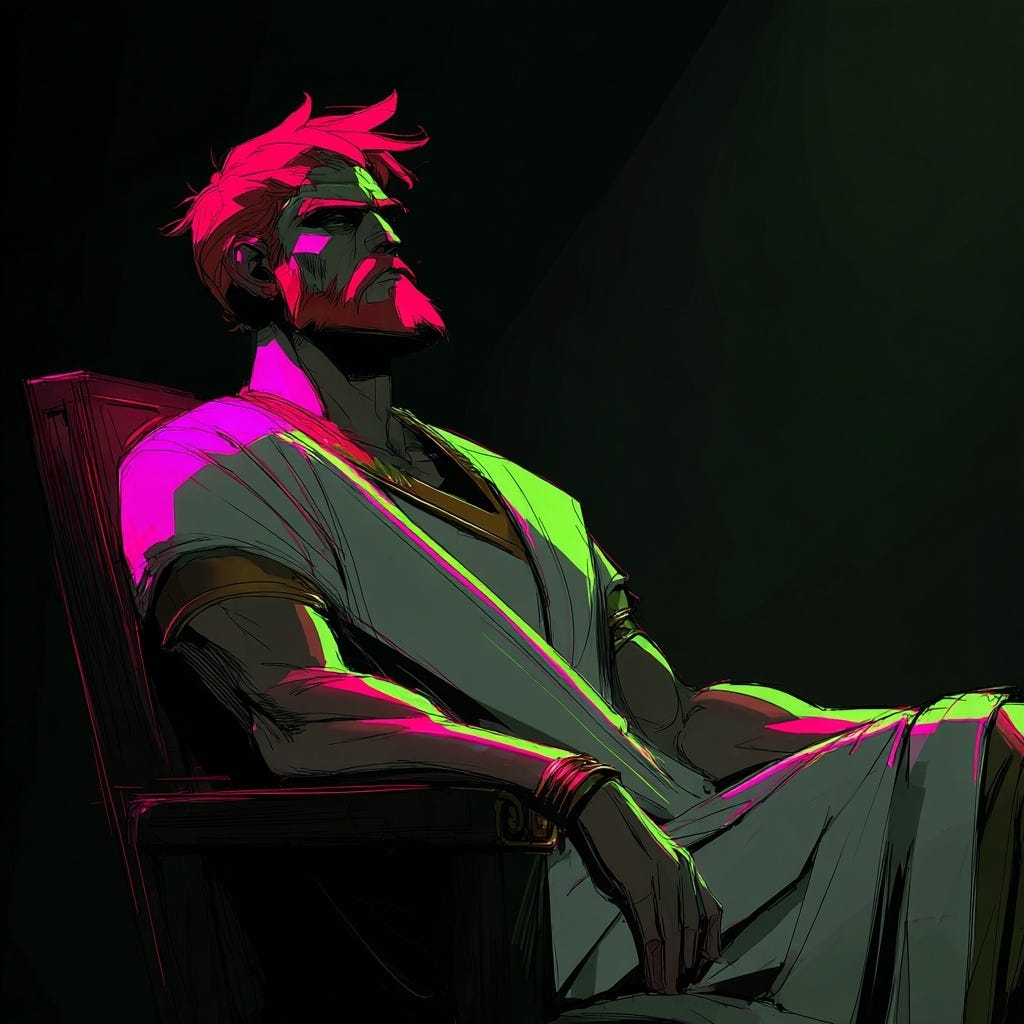
“Cursor.” Not ave, not salve. Just his name, checked off the list. “You’re well, I trust.”
“Well enough, patron. I’m grateful for your continued favor.” His favor. A handful of coins and the right to stand in this atrium. But without our obligations, we are nothing.
“Yes. Well.” Rufus waves a languid hand. “My father’s obligations remain my own.” He dips his hand into the strongbox and withdraws the sportula, but before he can proffer it, Sosias whispers in his ear. He nods at the servant, and the portly man hurries off to a side room.
“Stay a moment, Marcus Petronius,” he says, his voice growing a trifle warmer. Or at least, more interested.
Sosias returns, holding a folded tabula. The message is plain and unmarked, but small things signal its quality — the wax is pale white, not darkened from reuse, the wood is fresh and unworn, and the brass fittings shine as if polished yesterday.
“A messenger arrived late last night, from the Palatine. He requested my assistance in delivering a missive to you.” Rufus offers the tabula to Cursor. The ease of his gaze is gone; he now regards this lesser client with keen interest. A patron’s interest is an opportunity, Cursor’s father used to say. And Cursor hasn’t had the interest of the Acilius Rufus clan in some time.
“My thanks, patrone.” Cursor bows his head and takes the tabula. He opens it and scans the brief message:
Cursor—
A tavern called the Cockerel, on the Vicus Sobrius below the Esquiline Gate. You and Macro. Make haste. Tell the vigil on watch that I have sent you. He will show you what requires your attention. Investigate on behalf of this household.
He closes it, and stifles a groan.
“Do you require my assistance in this matter, Cursor?”
Cursor shakes his head. “No, patrone. Not at this time.”
Rufus looks disappointed. “Ah. Well, then…” A patron’s interest is an opportunity.
“But patrone, there is something— a separate matter.”
Rufus’ eyes narrow. “Yes?” He’s no fool. Make it good, Marcus.
“A client of mine, an honest and hardworking coppersmith, has become entangled in a dispute with a supplier. The man is demanding twice what was promised, and before the Ides. My client can produce the original sum; He honors his debts. But not the extra, and so quickly, patrone.”
Rufus leans back in his chair and studies Cursor closely. Now let’s see what the shine of the Palatine is worth.
Now let’s see what the shine of the Palatine is worth.
“I’ll have my secretary send a letter. What’s the supplier’s name?” Acilius Rufus’ calculations, whatever they might be, have fallen in Cursor’s favor.
Cursor gives it, with no small relish. Sosias, standing by, dutifully commits it to memory.
One small victory, at least. Now, let us see what Amphion has in store for us.
Cursor tucks the tabula into the fold of his toga and accepts his sportula with a bow. The coins are cool and heavy in his palm. “My gratitude, patrone. For everything.”
Rufus waves him away with that same languid gesture, but his attention lingers on Cursor as Sosias brings up the next man.
Outside, the morning sun has climbed higher, and the heat presses down on the Quirinal like a boot. Cursor squeezes through the narrowly opened double doors and spots Macro immediately—the big man is impossible to miss, even in a crowded street. He’s leaning against a wall across from the gate, jaw working steadily on a thick, grey sausage, grease shining on his scarred chin.
The smell of garlic and garum hits Cursor as he crosses the street. “Well?” Macro swallows and wipes his mouth with the back of his hand. “Quo vadis6?”
“That’s vadimus7, Macro.” Cursor pulls the tabula from his toga and shows it to Macro. The big man squints at the message, lips moving slightly as he reads.
“The Cockerel.” Macro grunts. “I know the spot. Friendly place, if you’re in with the landlord.”
“And if you’re not?”
Macro grins. “Let’s go.”
They descend back into the Subura, and the stench rises to greet them again. The Vicus Sobrius runs deep into the valley’s heart. The insulae here lean against each other like drunkards, their upper stories jutting out over the street until only a narrow strip of sky remains visible above. The morning crowds have thickened—hawkers cry their wares from doorways, a wagon loaded with amphorae blocks an intersection while its driver argues with a merchant. The smell mingles fish and dung, bread and sweat, and is as thick as a fog.
“Here.” Macro stops before a building that looks no different from its neighbors—five stories of weathered brick and crumbling plaster, ground floor given over to commerce. A faded sign hangs above the entrance, paint flaking away to reveal bare wood beneath. A rooster, its tail feathers spread in challenge. The Cockerel.
Three vigiles wait outside—a rare sight to see the watchmen in the light of day. The locals watch from a distance, out of respect for the drawn cudgels and nervous, edgy looks. As they approach, Cursor catches whispers from the onlookers — ‘The beast. The beast was here.’
The locals watch from a distance, out of respect for the drawn cudgels and nervous, edgy looks. As they approach, Cursor catches whispers from the onlookers — ‘The beast. The beast was here.’
The nearest vigil—a lean man with a week’s worth of stubble and eyes that haven’t seen sleep today—straightens when he spots them approaching. His hand tightens on his cudgel.
“No entry,” he says. His voice cracks slightly. I’ve seen that look on men walking away from their first battle.
Cursor reaches for the tabula, but Macro moves first, stepping close enough that the watchman has to crane his neck back to meet his eyes. “We were sent. Amphion.”
The name hangs in the air between them. Cursor studies the watchman’s face carefully. Fear, yes, but also relief. Whatever waits inside, the man is grateful someone else will have to deal with it.
Cursor clears his throat. “What’s your name, vigil?”
“Decimus Veturius, sir. Second watch, fourth cohort.” The formality steadies him.
“What should we expect in there?”
“I… It’s bad, sir. We three were first here, about two hours after midnight. A woman chased down my patrol, said she heard screaming from the upper floor. By the time we got here, it was all over.”
“And what did you see?”
The man pales. His eyes dart out to the crowd of locals, watching them like crows on a battlefield. “Two, maybe three bodies. Best you see it for yourself, sir.”
“Where’s the woman now?” Macro says nonchalantly.
“Gone, sir. She ran off.” Macro rolls his eyes. The man’s never been good at hiding his contempt.
“‘Course she did. Who’d want to hang around a fucking murder? Can you find her, Orion?”
“Nevermind that, vigil,” Cursor says quickly, with a sharp glance at Macro. “No need to run about, asking a lot of questions about this. Folk here are afraid enough as it is.”
Macro grunts, but concedes the point, shouldering past the vigil. “Let’s get this over with, then.”
He pushes the door to the Cockerel open and ducks in, with Cursor close behind him, but then smacks solidly against the big man’s back. Titus Antonius Macro, given pause? He peers around the veteran’s broad shoulders.
It’s definitely more than three bodies.
Thanks for reading this Chapter 1 sample of The Beast of Rome, a supernatural-noir serial story set in the early days of the Roman Empire! Whether you’re a longtime reader of PTFO or a newcomer to the stack, I’m eager to know what you thought of it: Was it worth the pixels, would you be interested in reading more, and what, if anything, you dug about it.
Thanks, as always for reading, and we’ll return to Vahid and Mado in the Betrayer’s Barrow next week!
A rural region northeast of Rome, known for pastoral countrysides and solid, old-fashioned country folk.
A specialized slave whose role was to remember the names of clients and other important personages for their master.
The Kalends is the first of the month.
In the era of August and Tiberius, the Illyrican provinces, Dalmatia and Pannonia, were in open revolt against the Empire. Augustus believed it was the greatest threat to Rome since Hannibal.
The Ides are the 13th or the 15th, depending on the month.
‘Where are you going?’ A Latin phrase made popular in a famous Christian legend about St. Peter encountering the risen Jesus on the road out of Rome.
“We are going,” is both a grammatical and a factual correction.
Love this. Very immersive. It felt like HBO's Rome (in a good way)
I enjoyed this, excited to read more. Strong ending. The interaction between Macro and Cursor is delightful.