Anwen flies, and Vahid follows. Padrig and Mado face Cerys.
Mar 23, 2026
Recap & Poll Results
Last episode, Vahid and Mado returned from the Barrow of the Thrice-Betrayer bearing Stormcatcher’s Crown. With Vahid’s body failing, they had little time—he and Anwen descended into the Makers’ sanctum beneath Stonetop to activate the Stormbinder, the ancient device that once created Indrasduthir’s nine storm-blessed warriors. Activating the arcanum served a dual purpose: It would allow Vahid to survive with the storm-spirit inside his unliving body, completing his transformation into some new sort of being. It would also transform Anwen into a storm-marked warrior, imbued with the swiftness of the wind and the strength of a thunderbolt.
Beneath the hill, Anwen and Vahid cleansed themselves in the enchanted pools, then entered the Stormbinder’s chamber — a vast black vault dominated by a sphere of aetherium crackling with lightning. Vahid donned Stormcatcher’s Crown, and the device answered: lightning tore through him and into Anwen, searing storm-marks into her flesh. But the process was overwhelming. Anwen rose to her feet with Maël’s spear blazing in her hand, the fury of the storm demanding release. Vahid called her name, but the storm was louder.
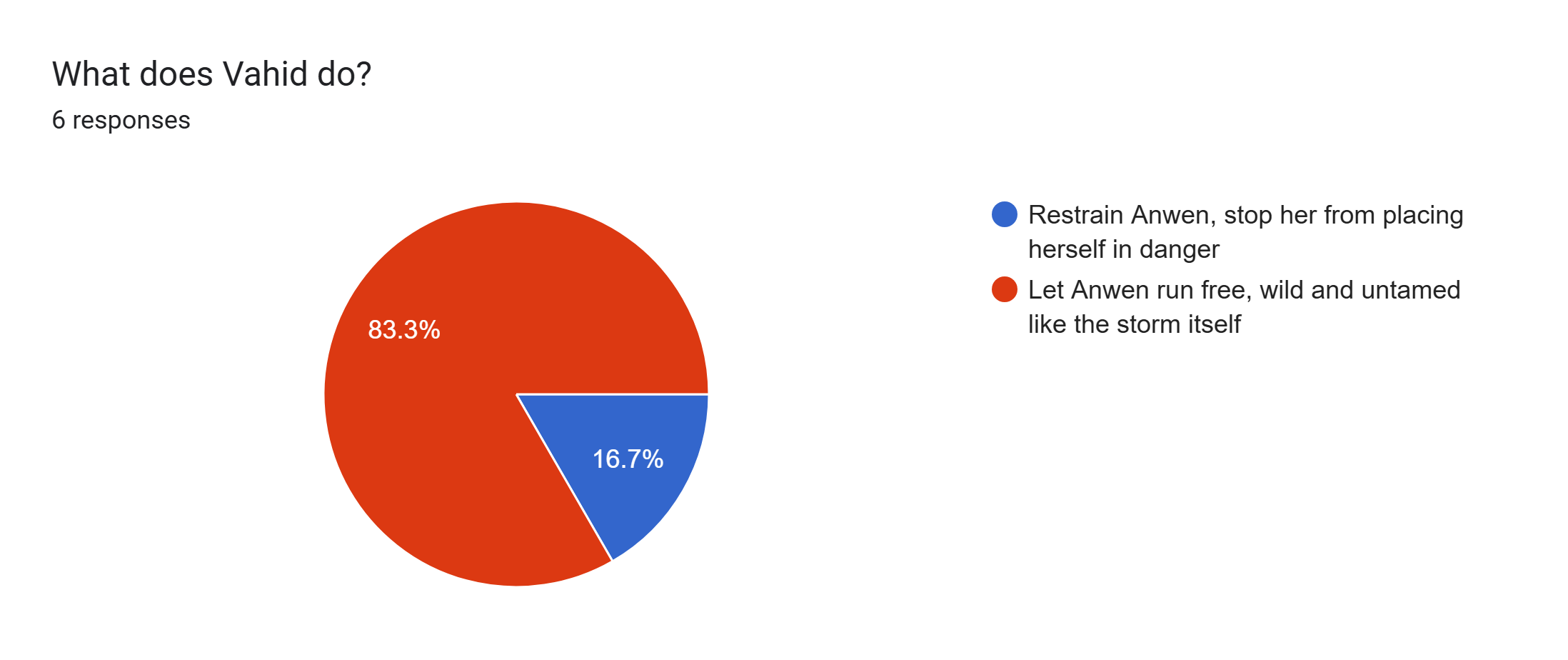
This was the subject of last week’s poll: would Vahid restrain Anwen, or let her run free?
Vahid seems to believe that a show of power here might do the village some good, and so he chooses to let Anwen run free. Before we see that choice realized, we’ll join Mado and Padrig, who are awaiting some sign of their friends below. Back to the action:
Scene 3: The village green, near the cistern
The rain begins to fall, cold for mid-spring, driven by the wind that bore Vahid back to Stonetop, and that has been growing ever since the Seeker and Anwen descended into the Makers’ sanctum. Padrig stands with his back to it, his cloak sodden and heavy, watching the dark mouth of the cistern. Beside him, Mado sits on the wet grass with his knees drawn up and his cloak pulled over his head. Cerys’ son hasn’t spoken in some time. The flight home must have been harrowing—when he came off the wind at the edge of the village, his lips were blue, and his legs buckled, and Padrig had to steady him with both hands before the lad could walk.
Brogan holds a guttering torch a few paces off, though the rain is doing its best to kill it. The young man’s golden eyes catch the firelight, and Padrig can see the tension in him, in how he stands alert and ready despite the rain.
He’s not the only one watching. A knot of villagers has gathered around the green despite the hour, watching from open doorways and beneath the thatched eaves of the Pavilion of the Gods. Among the crowd, Pad spots Rhys and a handful of men from his work gang, old Cadwyn in his nightclothes, and Rheisart, his face lined with worry for Anwen.
They know something is happening beneath their feet. When Padrig and Vahid first discovered the strange ruins beneath the village a year ago, Cerys warned the Stonefolk not to meddle with the old places, and rumors spread about what was found below—some cursed treasure, a terrifying beast, a powerful Maker’s tomb. Now their Marshal-and-champion has gone down into the dark, with the Seeker who looks more like a stranger to them every day.
Perhaps an hour, now. Padrig marks it by the burning down of Brogan’s weak, guttering torch. The storm is a dense and unnatural one—not rolling in from the Flats the way spring storms do, but gathering directly above the village, swirling above the rune-carved standing stone. The thunder has been low and steady, like the beating of Tor’s own heart.
“You’ve been a friend to this Seeker for how long, now? A year?” Mado’s voice is surprisingly clear and steady, for what he has been through.
“Near on two, now.”
“When I was a guest in Jarl Dane’s hall, a travelling hexxer came to our table, and offered his services. He carried himself like your man Vahid.” Mado pauses, and looks up into Padrig’s eyes. “He is your man, is he not?”
Padrig hesitates. Is he, still? The oath we swore together1 during the winter’s kinstrife cannot be forsworn short of death. But he has died and returned. The old bandit shakes his head, banishing these doubts as best he can. “He is. We are bound by oath, and we’ve left blood on the same battlefields.”
Mado holds his palm open under the rain as he listens, as though he was weighing Padrig’s words in his hand. He marks my hesitation well, but he knows what shedding blood together means. He’s Cerys’s son, all right. “What became of this hexxer in Jarl Dane’s hall?” Pad asks.
“He was a charlatan and a villain. Any powers he commanded were only useful for tricking men out of their rings and leading wives astray. He claimed any man who pierced him with a blade would be cursed by the Things Below, so one of the Jarl’s sworn shields fed him to his hounds.”
“Vahid is no charlatan. I have seen his power.”
“So have I.” Mado lets the silence stretch for a while. “Is he a villain, then? Wielded by his power, as my mother fears he is?”
Pad hesitates again. If it were not for Vahid’s advice, belike I wouldn’t be here. I’d have fallen back in with Brennan at Marshedge, squeezing merchants and working folk for their coin. Watching Ivan Iron-Eye leer at their daughters, dreaming about cutting the devil’s throat in his sleep. But that was before the bloodbath in Odo’s lair, when he took the storm inside himself to save our lives. “He is no villain. The counsel he has given me, and others, has always been wise and good. And he has saved my life, more than once.”
“And what of this sorcerer? Cirl-of-the-Storms? Is he the great destroyer our kith and kin fear he is?”
“Yes. His magic tore Gordin’s Delve apart. I saw it with my own eyes. And his warriors are true killers. No doubt you met their kind in the Jarl’s service.”
“Aye, I know them well. We could use some of them at Stonetop.” Padrig studies his face. Looks like you are one, now. Not much is left of the boy he knew before he left Stonetop, living in his brother Owain’s shadow.
“We have a few.”
“Too few.” He rises, shaking rainwater off his tonnerhorn fleece. “The village is in dire straits, then. The sorcerer will come with his warriors. They’ll aim to wipe us out. I’ve seen it done, in the Marches. Houses emptied, women and children put into bondage, every man’s throat cut and corpses burnt inside the Gothaus2.”
Padrig nods. “That’s the way of it.”
“And that hexxer has the power to stop it.”
The old bandit looks Mado in the eyes. “If I knew of another way, I’d be about it.” Yes, boy. Tally up the bloody accounting, like I have.
They are silent for a while longer. Then, Mado lifts his head. “Feel that?”
Padrig does. A tremor in the ground, faint but growing. The torch in Brogan’s hand flickers and spits, and across the green, the standing stone begins to hum — a low, resonant drone that Padrig feels in his teeth before he hears it. The villagers beneath the Pavilion eaves stir and murmur. Old Cadwyn clutches his shepherd’s crook and backs toward his doorway. Rheisart stands his ground, but his young face has gone pale.
The hum deepens. A branching, white claw of lightning reaches down and grasps the standing stone. The boom of thunder seems to bring everything to a halt — for a moment, the rain stops falling and hangs in the air for a heartbeat, suspended, as though the world itself is holding its breath. Then it drives upward, and the wind comes with it, shrieking out of the cistern’s mouth like something escaping. Brogan stumbles back, his torch torn from his hand and snuffed. Padrig seizes Mado’s arm and hauls him to his feet. “Get clear of the —”
Lightning strikes the standing stone again. In its flash, Padrig sees everything: the villagers scattering, Brogan on his knees with his hands over his ears, the wet grass flattened in a perfect circle around the cistern.
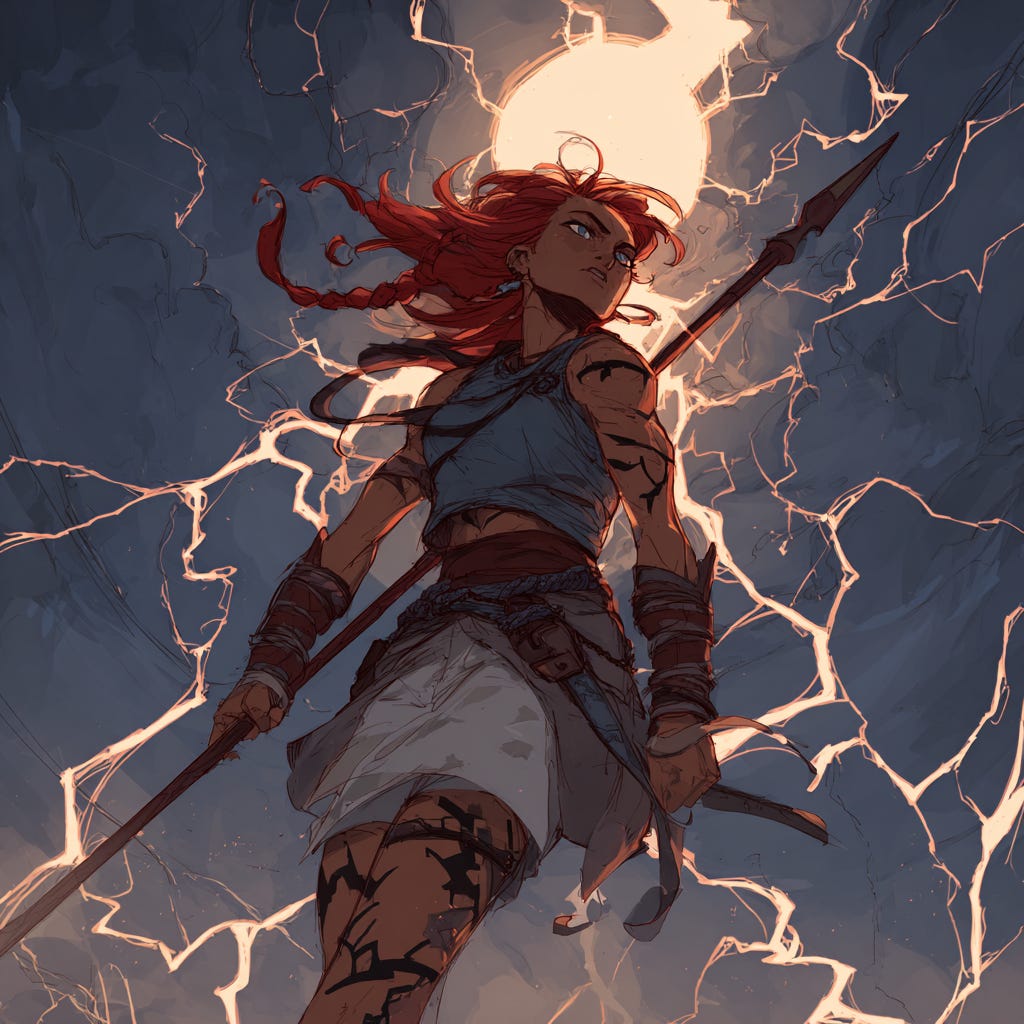
And then she is there: Anwen, rising from the dark, wreathed in storm-light, her eyes blazing, Maël’s spear in her hand, trailing a corona of blue-white fire. Padrig calls out to her, but he cannot hear his own voice, and Anwen does not see him. The wind takes her, and she is gone, tearing across the green and down the hill towards the Flats, the thunder following her like a war drum.
I am the Thunderhead. // Source: Midjourney
Silence rushes in behind her, broken only by the hiss of rain on wet stone. Padrig’s ears are ringing. Across the green, someone is crying out — a child, woken by the thunder, and the assembled crowd stirs with fear and uncertainty.
Then Vahid rises from the cistern on a column of wind, and Padrig barely recognizes him. The hunched, dying man who descended an hour ago is gone. He stands straight, his scarred skin flushed with color. His pure blue eye shines with inner light. The Azure Hand hums in his grip. Stormcatcher’s barbed crown still rests on his brow, dark with blood, but the bleeding has stopped. He looks restored. More than restored.
Padrig seizes him by the arm. “What has happened to her?” He’s shouting; if he does not shout, he fears he cannot hear his own voice.
“She has become one of the Thunders.” Vahid’s voice is steady, but in Pad’s ears, it is a whisper. “And now she must learn the extent of her power.”
“Could you have stopped her?”
“Yes.”
“Why didn’t you?”
Vahid meets his eyes, and for a moment, Padrig sees a flash of anger in his eye. Then it passes, and it is Vahid again: tired, earnest, a little too certain. “She would not have thanked me for it, Padrig. Nor would you, when the sorcerer comes.” The wind gathers at his back. “See to the village. I will bring her home.”
And then he is gone, rising into the sky, and Padrig is left standing in the rain with his hand still outstretched where it held Vahid’s arm.
Padrig turns to the village green. The villagers are emerging again — frightened faces in doorways, hushed voices. Brogan has found his feet, though his hands are still shaking.
“Brogan. Go find Ozbeg, and the two of you rouse Judge Garet and do whatever he bids you. I’ll be along shortly.”
The young man nods and is gone, grateful for an order to follow. Padrig turns to Mado, who is watching the sky where Vahid vanished with an expression Padrig cannot read.
"Mado. What happened in that barrow?"
Mado’s playing his cards close to his vest here—the Thrice-Betrayer revealed some critical information: Specifically, that Vahid carries a piece of Stormcatcher’s consciousness in his mind. But he doesn’t want to share everything just yet. He’ll use the Silver-Tongued move from the Fox playbook to withstand direct scrutiny or questions — assuming he can roll at least a Weak Hit here:
Mado triggers Silver-Tongued: 6+2+1 Charisma = 9, Weak Hit
This gives him 1 Hold which he can spend immediately to lie directly to Pad’s face without the canny old bandit catching wind. It’s good to be the Fox!
N.B. — PbtA games often play fast and loose with PC-on-PC actions. Moves like Silver-Tongued can be seen as taking away player agency, and they absolutely do: With this result, by the rules-as-written, Padrig’s player must let the issue drop, at least for now. But of course, as solo players, we can just ignore that little wrinkle and let the dice fall where they may!
Mado is quiet long enough that Padrig thinks he might not answer. “The thing in the tomb spoke to him. I could not understand what was said. I’m not sure he’s the man you knew anymore, Padrig.”
“Then what kind of man is he?”
Mado’s brow furrows. “I don’t know. He saved my life, more than once. But he needed me to survive.”
Pad frowns. Does he still need Anwen and me? Or Stonetop? It is hard to imagine the young man that Vahid was, turning his back on his friends to grasp at greater power.
Before he can press further, a figure comes hurrying across the green — Cerys’s apprentice, a slight girl with her shawl clutched against the rain. She is breathless, and her eyes are wide. “The elder calls for you. Both of you. Please, come now.”
Mado’s jaw tightens, and he turns to follow the girl without a word.
Padrig falls in beside him. The rain is easing now, as though whatever was drawing the storm has gone with Anwen. The village is quiet, but not peaceful: Stunned, every door closed, every shutter drawn. He can feel the eyes behind them, watching as they make their way to the House of Healing.
Scene 4: The House of Healing
The House of Healing lies against the hillside, its moss-covered stone walls dark with rain. Smoke rises from the chimney hole. The ancient hazel tree growing over the hut is heavy with rainwater, its branches sagging under the weight of the small offerings that hang there: rough clay lanterns, bundles of bone, crude stick-and-twine figures. They turn and drip in the wind like little hanged men.
Mado ducks through the low doorway without breaking stride. He knows the smell of this place better than any other — the juniper, the sealed clay vessels, the prickling spice that clings to everything his mother touches. He slept in this room as a boy, curled on a mat by the fire, listening to her murmur supplications to Danu while the wind shook the hazel tree outside. Before she sent him away, lest Owain murder him in a rage.
The interior is dim, lit by the hearth-fire and the narrow shafts of light through the smoke-hole. Bundles of herbs hang from the rafters, and the walls are lined with earthen vessels sealed with beeswax. Behind him, he hears Padrig hesitate at the threshold. Mado smirks. Before my blessed mother, we are all but chastened children.
Cerys sits cross-legged on her woven mat beside the fire, her back straight as a spear despite her years. Two mats have been laid before her. She was expecting them, and only them.
She rises when she sees him. The effort costs her — Mado can see it in the way her hand presses against her knee, the tremor in her bony arms. She is old. It is easy to forget just how old. In his memory she is ageless, the immovable center of the village. But the woman who reaches for his face with both hands is frail, and he wonders whether all he knows is already laid bare before that gaze.
“My son. You are home safe.” Her palms are warm and dry against his rain-cold cheeks. She smells of juniper and tallow and the bitter herbs she burns for Danu. He stands rigid under her touch, and he can feel Padrig watching from behind him.
Your mother has betrayed you all in turn. The Thrice-Betrayer’s hateful voice lingers in Mado’s ears, and bile rises in his gut. Sent your father to his death, your brother to exile, and you into a den of wolves.
“Sit,” Cerys says, and her voice is steady again. The moment of tenderness passes like a cloud across the sun. She turns to a clay pot on the hearthstone and ladles something steaming into a cup. “Drink. You have undertaken a great ordeal for our village.”
Mado takes the cup. The brew is bitter and hot, and it warms the path down to his stomach. He can feel that warmth spreading through his limbs almost immediately — whatever is in it, it is more than simple tea — the product of his mother’s craft, somewhere between man’s physik and the ways of the gods. He drinks deeply, and says nothing.
Her dark, cloudy eyes regard them both. “So. It is done. What has become of Anwen?”
Padrig tells her. Plainly, as is his way — the storm building, the standing stone, the eruption from the cistern’s depths. Anwen blazing with storm-light, deaf to their calls to her. The wind taking her out across the Flats. Vahid rising after, seeming stronger and more hale than ever. His departure, on her heels.
Cerys listens without interrupting. Her fingers work at the bone beads around her wrist, and she glances at Mado’s face for any sign from him of Padrig’s forthrightness. Mado strives to give her nothing.
“I had hoped you would turn her from this path, Padrig. You know better than any man in this village that the choice to follow a bloody path can consume your whole life.”
Padrig straightens. “Anwen is not mine to command — I swore an oath3 at your behest, Cerys, to never take up that mantle. She made her choice.”
“Yes. She is young, and brave, and has never yet refused a burden placed before her,” Cerys says, her face darkening. “That is what makes her so easy to use.”
Easy to use. Like Owain was easy to use? Like father was? Like me? Mado grips the clay cup in both hands and keeps his quiet.
“Anwen didn’t ask for any of this,” Padrig says. “Neither did Vahid. The hdour is coming, Cerys. What would you have us do — face him with spears and courage alone?”
“I would have you understand what you have put in motion.”
“If you have wisdom to share, mother, then share it,” Mado says, finally breaking his silence. You always hoarded your secrets. Even from your own family.
To his surprise, his words seem to wound her. Her brows knit, and she looks away, staring into the fire as she continues. "When I was a girl, the Forest Folk still dwelt in the Great Wood. My grandmother, who held Danu's mantle before me, would go to them at the turning of the seasons. They have lived here, for as long as the Stonefolk, and their memories were long. When their elders told tales of days gone by, their children marked them well, and remembered.” With these words, she shoots a reproachful glare at Mado.
“Like the Hillfolk, they whispered stories of the fearsome warriors of the Storm Hill—stories that we have buried for good reason. But more than the warriors of Storm Hill, the Forest Folk feared one thing above all else: The-Storm-Who-Walks, the greatest among the Makers, who could command the thunder and lightning in their own elder tongue, and built a great tower, from which every hidden place in this land and the Great Woods beyond could be seen. But by her own power was she undone — her servants stole her secrets and betrayed her, bringing all her works to ruin.”
“This is Stormcatcher by another name,” Mado says. “Even in the Marches, that name is known.”
“Good, my son. I am glad you have not forgotten the past, like so many of the young.” Mado grinds his teeth. I am a man, mother. You made sure I would become one quickly when you sent me to live among Jarl Dane’s wolves.
“When the Forest Folk told these tales to my grandmother, Stormcatcher had been dead for many ages. But they also said this: If any fool should meddle with the old powers, The Storm-Who-Walks would return. That she had found a way to cheat death, to pass back through the Last Door.”
Stormcatcher did not die, little vessel. She spread herself to the four winds and the nine thunders. The wight’s voice scrapes through Mado’s memory.
Pad breathes deep. “You truly think one of the Makers could return? After all this time?”
“Can you doubt it, after all you have seen? Vahid is meddling with these very powers, Padrig! If these stories are true — even in part! — he could be beckoning back into this world a power far greater and more terrible than this sorcerer who threatens us.”
Padrig is now looking into Mado’s eyes. He wants to know what has become of his friend. You want the truth, Padrig? These old wives’ tales are already coming true — The Maker is inside Vahid, right now, flying through the storm after Anwen.
Cerys too turns back to Mado. Her voice softens, and that softness immediately puts Mado on guard.
“My son. You went into the Thrice-Betrayer’s tomb. You saw what became of the last men who wielded the storm-kings’ power. What did you learn there?”
We’ll freeze the scene right there, and take a moment to decide what exactly Mado tells his mother.
On the surface, this is a smaller decision, about what Mado does in the moment. But Mado is a relatively new character to the story, and we don’t have the full measure of him yet. As a result, choosing what he does also gives us a clearer picture of who he is, and how his future actions might move the story.
Mado has learned from two teachers throughout his life. He grew up in Stonetop, under the hand of a mother who governs through tradition, caution, and — as the Thrice-Betrayer revealed — a willingness to sacrifice even her own family for what she believes is the greater good. Then he was sent to Jarl Dane’s hall, where he learned a different set of lessons: that power is a tool, that dangerous men can be useful allies, and that the world belongs to those bold enough to seize their moment.
Now he sits between those two worldviews with the most consequential piece of information in Stonetop.
If Mado tells Cerys what the Thrice-Betrayer revealed — that Stormcatcher didn’t die, but scattered herself across the storm-spirits, and is now present inside Vahid — he’s siding with tradition. He’s giving his mother a weapon she needs to move against Vahid, because the old ways say that this kind of power must be destroyed before it destroys everything around it. It means Mado sees Vahid as a threat to be managed and, when the sorcerer is dealt with, disposed of. It means he has decided that his mother’s way — cautious, ruthless, protective — is the right one, even knowing what it has cost his family.
If Mado holds his tongue, he’s making a bet his mother would never make. He’s looking at Vahid and seeing not just a threat, but a possibility. After all, he has seen evidence that Vahid is still in there, along with whatever else now inhabits and guides him. Stonetop has always been a small village clinging to a hilltop, trying to survive. Vahid and Anwen are becoming something that could change that, permanently. If Mado stays silent, he’s choosing to protect that potential, to let the transformation play out, to see what Stonetop could become—even knowing the risks, even knowing he might be wrong.
Before we close out the episode, let’s tackle one more thing: a little post-credits scene to check in on our champion:
Scene 5: The Flats
The riders found her on the open Flats, a day’s ride from Stonetop.
She does not know how long she ran. The wind carried her faster than any horse, faster than she thought possible, and the world blurred to a rush of dark grass and silver rain.
When the gale finally slackened, and her feet found the ground again, she was standing on a rise she did not recognize, a great furrow in the grass and earth behind her, Maël’s spear still crackling in her grip. Her storm-markings pulsed with a fading blue-white light beneath her skin.
Then: hoofbeats. She turned and saw them coming hard across the grasslands — a band of riders, their shields and horses painted with the Stormcrows’ grey wings and white raven skulls, shortbows already in hand. This far west, this close to home. They’re watching us. The thought roiled Anwen with rage, and the markings on her arms sparked to life again.
The first arrows came in a volley. She watched them rise, arc, and fall only to be swept up in a whirlwind around her. The riders fanned out, circling, loosing as they rode. She stood in the center of their ring and felt nothing.
She let loose a war-cry that resounded like thunder on the plains—the roar set their horses to panicking; The skilled riders struggled to control them, and others were thrown from the saddle. Distantly, she hoped that they would be more wise than brave. That they would run.
They were brave.
She raised her spear, and the storm answered.
It was over in moments. Streaks of lightning lanced from her spear’s tip in branching arcs that found the riders and their mounts with terrible precision. As they closed, shouting their battlecries against the wind, the thunder set the battle-rhythm, each strike landing with Tor’s own fury. Men fell, their armor scorched and smoking, thrown from the saddles as their mounts turned and fled or collapsed to the ground in sheer terror. One rider, faster or luckier than the rest, wheeled his mount and made for the open Flats, but the wind caught him and hurled him from the saddle like a child’s doll.
Then silence. The rain falling soft and steady on the trampled grass.
Anwen stands among the dead and cannot feel her hands. The spear’s corona has faded to a dull flicker. The storm-marks on her arms are dimming, the blue-white light retreating beneath her skin like embers cooling. Around her, the Stormcrows lie broken in the grass — men and horses, scattered across the rise in a rough circle. The smell of ozone and burnt leather hangs thick in the wet air.
She counts them. Twelve riders. And she is not wounded, nor even winded.
Maël said when I slew him, that I stole his powerful fate.That I would never know peace again. That pain and death would be my only trade4. She turns over the nearest body with her foot. A young man, a bit younger than she. His face is frozen in surprise, his bone-stitched armor still smoldering at the edges.
A sound on the wind. She raises the spear before she can think, but it is Vahid, descending from the dark sky on a column of air, his rags billowing around him. He lands lightly, the Azure Hand clicking against the stone beneath the grass, and takes in the scene without expression.
For a long moment, neither of them speaks. Vahid’s glowing blue eye moves across the scattered dead. Then he looks to her.
“Stormcrows,” she says. Her voice sounds strangely quiet in her own ears. “A dozen of them. They were a day’s ride from the village.”
Vahid nods slowly. “The sorcerer’s forces are moving. More have joined his cause since his victory at the Delve.”
“They couldn’t touch me. Their arrows couldn’t reach me. Their blades never came close. I just —” She stops. The spear trembles in her hand.
Vahid steps closer. The rain falls between them. “You did what the Thunders were made to do, Anwen.”
She looks down at the dead boy at her feet. The scorch marks on his armor. The surprise still written on his face. “Is that supposed to comfort me?”
“No,” Vahid says. “It is supposed to prepare you.”
And there’s where we’ll end for the week! If you haven’t voted in the poll above, DO IT! If you have, sound off in the comments about why you chose what you chose, or any old thing at all.
Way back in Session 9, Owain — Cerys’s eldest son, and at that time Stonetop’s marshal and strongest warrior — challenged Anwen’s right to lead the village’s defenses. The dispute escalated into a formal duel, which Anwen won decisively. Before committing themselves to such a course, Anwen, Padrig, and Vahid swore an oath over their shared hearth to stand together and protect Stonetop after Owain’s defeat. It’s one of the foundational bonds of the party.
A Manmarcher term for a communal temple or god-hall — the equivalent of Stonetop’s Pavilion of the Gods. Mado spent his formative years in Jarl Dane’s court, and sometimes his vocabulary shows it. The Manmarches are a rougher, more militarized culture than Stonetop, and their religious practices reflect that — a Gothaus is as much a place to swear war-oaths as it is to pray for rain.
This is another callback to Session 9—during the kinstrife between Owain’s faction and Anwen’s, Cerys coerced Padrig into swallowing an oath-seed — some Danu magic that would kill him if he broke his oath to never seek the title of Marshal of Stonetop.
Back in Session 14.3, Anwen faced Maël — one of the sorcerer’s most dangerous servants, a Hillfolk champion bearing aetherium-forged armor that made him nearly invulnerable. Anwen shattered her Makerglass axe against him, but ultimately prevailed. As he died, Maël told her she had stolen his “powerful fate” — a not-uncommon concept in warrior cults where a man’s destiny can be claimed by the one who kills them.

Voted for Mado to keep his council, be his own man. And yet…. My heart says in this, Cerys is right…
I voted for Mado to keep his cards close to his chest. Knowledge is power, France is Bacon as they say. :-)
Anwen faces a fearsome task to retain herself against the storm. I hope she does better than Vahid.