Vahid dreams of the fate-tree. A traitor in the camp is revealed.
Jun 08, 2026
Recap & Poll Results
Welcome back to PTFO:Stonetop! In session 16, we saw the end of a long-standing thread: Anwen received the storm-marks, transforming her into one of the Thunders—an ancient order of warriors who fight with the storm’s power. From there, the party turned their attention to the village’s defenses and supplies: The militia drilled, the wall rose, the smithy was lit, and the fields came in strong.
Then the village set down its work and feasted: a day of games and wedding rites, with Padrig and Heledd married beneath the Pavilion—Cerys’ plan to heal the wounds of old kinstrife. And as the revel ran late into the night, Vahid returned from a journey to Gordin’s Delve, descending out of the dark with the Azure Hand shining in his grip. He did not come to join the feast. I have learned much of our enemy’s schemes, he told Anwen. We must speak.
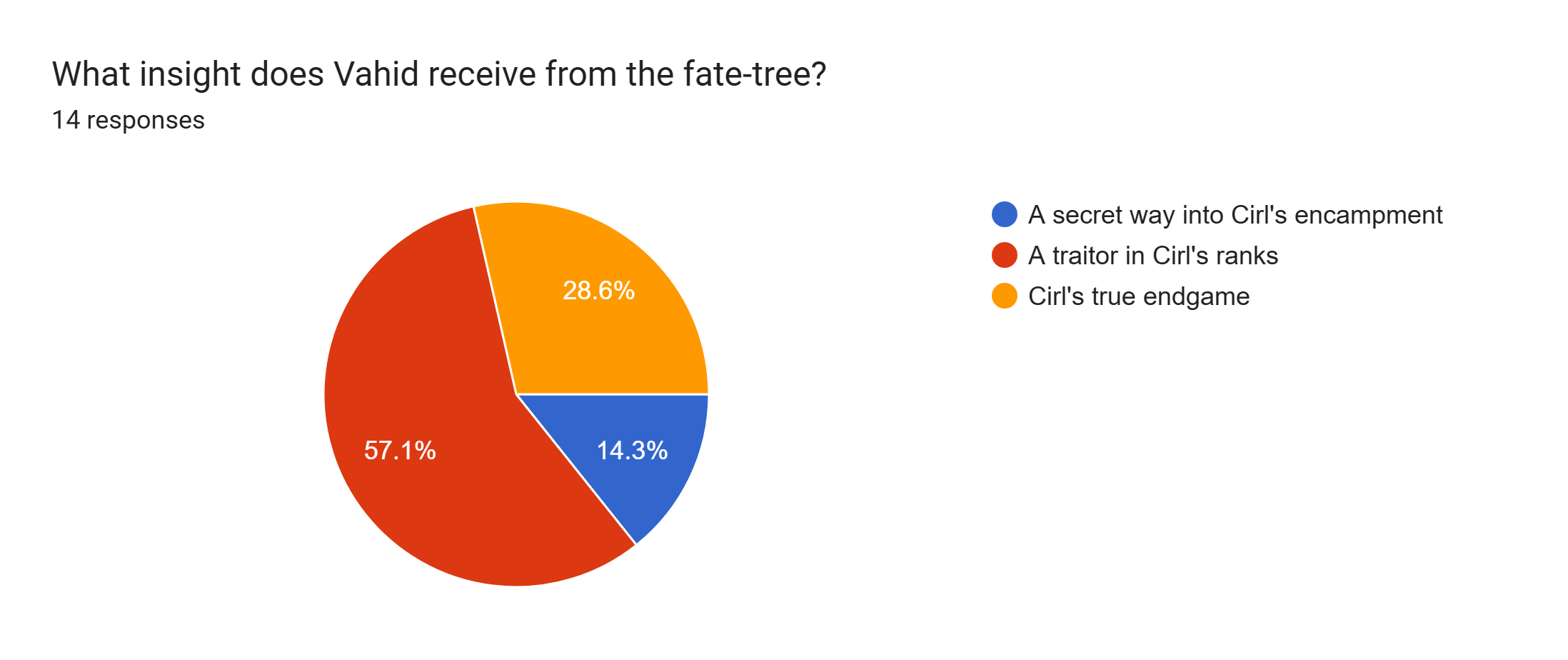
To determine what exactly he’s learned, we wrote a custom Love Letter move in last week’s GM Planning episode. Vahid scored a weak hit and the choice was left up to the readers. Let’s see where the votes fell:
The visions reveal a traitor within Cirl’s camp. Rather than just having Vahid recount things, we’ll envision events with a flashback.
Before we dive into that flashback — this session draws heavily on things that were established some time ago, back in Session 7.5 and 7.6. In case you want to revisit Vahid’s last journey to the fate-tree, here are the links:
He comes alone, on the wind, in the grey hours before dawn. He left when the Delvers still slept, tired from their labors in the fields he has watered. Abrim saw him go — the Judge no longer attempts to command his comings and goings, any more than he could command the wind.
The Flats stretch out beneath him, rolling and endless, the ancient Maker’s Road a black seam stitched through the waves of gold and green. Far to the west, the broken finger of the Ruined Tower stands against the dim stars. Vahid’s eye avoids it — whenever he looks, it seems to exert a strange pull upon him. He flies on toward the Huffel Peaks — black slabs of granite and basalt, crowned with late snows — and descends into the grave-narrow canyon.
For a moment, he looks at his reflection in the cold, clear pool in the center of the glen. The sun has tanned and toughened his face, and the pale lightning scars stand out against the brown of his skin. His beard has grown wild and grey, and the orbit of his lost eye is shadowed. As he is, his mother would not know him if he strode through the door of his father’s house, nor would his masters at the Lycaeum if he stood in that great hall. No matter. My path leads me elsewhere.
Above him is the towering, yellow-leaved tree, its spring raiment still trembling from his arrival. And there, half-buried in the hard-packed earth, lies the titan’s helm: bronze tarnished near-black with age, each eye-slit tall as a temple door, the tree’s white roots enwrapping it from above.
The last time, his cloak-spirit set him down here, and the spirit-talker Katrin led him into the helm, sure of her steps, telling him of the great destiny that lies decaying in this place. He had gaped like a child to see such wonders.
This time, he must walk into the titan’s eye alone.
The chamber within is as he remembers — walls of green bronze and twisting roots above, a floor of soft, damp earth, and the ring of mushrooms beneath the crown of the helm, with their soft and strange blue glow. He opens his mind’s eye, and the room fills with white light, motes of thought rising from the caps: regrets and wanting, drifting up on a breeze that Vahid cannot feel.
He kneels in the center of the ring. The memory of Katrin’s careful ritual slips through his fingers like smoke. No matter. He pulls one of the mushrooms from the circle, its roots come out of the soil with it, a delicate web of tendrils that form strange geometries before his mind’s eye. He closes both eyes tightly and bites. Chews.
The bitterness is overwhelming; his guts churn and heave. He falls to his hands and knees, and his stomach empties onto the cavern floor, first Delver gruel, then bile, then nothing as he gasps for breath. Then, he is on his back, looking up at the titan’s crown, which writhes and twists before his eyes like a knot of serpents. He remembers Katrin’s warm hand on his forehead as he descended into the dark, cold waters of the dead titan’s dreams. All around him, he feels that same cold pressing against him as the world falls into shadow, and he falls with it.
Scene 2: Elsewhere
The waters of the fate-tree are storm-tossed when Vahid breaks the surface, lungs aflame. Above, the vast, white trunk of the tree reaches towards the starlit sky, its boughs swaying wildly in the silent wind. Numberless golden leaves fall into the churning sea below, and Vahid struggles to float among them.
The fate-tree // Source: Midjourney
The water drags at him. It is not the still mirror he remembers; it heaves and folds, and the leaves slide across its surface like a scattering of coins, and every time he fights his way up to the air, another swell pulls him under. The weight of the roots below the water pulls him down, heavy with the regrets of the past.
Padrig’s voice calls in desperation: Vahid! Hold nothing back! He feels the thrill he felt when he first drank in the storm-spirit’s power and turned it against Odo Thriceborn, slaying him with a gesture. The first step on Stormcatcher’s path.
He struggles against the pull of the past—what he needs now is a vision of the now, where his enemy gathers. But the dark water wants him, and he feels animal panic rise as his strength goes.
Then, across the water, a voice.
Come to me, Seeker.
He knows it. He cannot say from where—many have called him that title since he first took it, before they began to call him by other names. It comes again, and he clings to it, and to his relief, it seems to pull him to the surface, to the present, towards the towering trunk of the fate-tree. He drifts. The leaves drift with him. And the turning sea sets him down at last against the base of the tree.
The trunk rises before him, white and vast, climbing past the reach of sight. Up close, its bark is not smooth but worked all over with whorls and fissures, intricate as watered silk. Before his eyes, the patterns shift and twist as he watches, and from them seems to come a whispering of far places and of fates swelling toward their ripeness, of all the ungiven things the titan dreams.
Come to me, Seeker.
He lifts his hand and places it upon the trunk, and he is elsewhere once again.
Scene 3: A rocky valley in the Steplands
She wakes from the meditation in the grey light before dawn, and the first thing she knows is that she is being watched.
She is seated on a flat shelf of stone above the camp, where she has passed the night with her mind cast out into the dark. Her knees have locked, and her fingers are stiff around the sun crystal cradled in her hands where it catches the dawn’s first light. Somewhere below her in the waking camp, there are eyes on her. They are watching again, her horse nickers. Dangerous men. The beast stamps her hoof nervously as she grazes at a knot of roots nearby. She silently thanks the beast, but does not turn at once — it would not do for these dangerous men to see her uneasy.
Before her, the Steplands rise in pillars of grey rock, shot through with water-carved caverns, each cave mouth surrounded by a cluster of tents and wagons. She travels that camp’s pathways with her eyes, counting their growing numbers, as she counts them every morning. Nearest, just under her perch, the white tents of her own folk— twice a handful of riders led by a pair of young, uncertain spirit-talkers who have followed her into this den of wolves. Her people’s cookfires are only now being coaxed to life, and they too are uneasy, an island of Heol’s children in a sea of strangers. Beyond her corner of the camp, ring upon ring to the edges of the valley, the storm-folk: wagons drawn wheel to wheel, banked fires in the caverns past counting, the horse-herds steaming in the cool morning air. Three dozen bands broken and shaped into one host. More spears than she has ever seen raised, more than she has ever heard tell of in her father’s and grandfather’s lifetime. They are eager to follow the glory of the man who burned Gordin’s Delve, and ended the stren’s unholy work in that unholy place.
Above it all, crowning the high ground to the north, the ruin. Pale limestone shaped by ancient hands, its broken arches dark against the lightening sky — an Old Masters’ watchtower, older than the tu’d itself, the gathering place for the hdour’s growing host. She can feel what lies beneath it even from here: an electric presence in the unseen world, ancient and restless. The Thousand-Year Storm, caged in the Old Masters’ crystal, waiting. Some nights, when the wind comes off the hill, she can hear her song. She must be freed and allowed to pass from this world. Nothing else matters.
When she turns at last, the watchers are who she knew they would be.
Two of them, standing easy at the foot of her perch where the path comes up — Cirl’s new creatures, the pair he keeps close since the burning of the Delve. The big one is called Marweth, and he is built like a standing stone, bare-chested in the morning chill. His chest is criss-crossed with lightning scars. Folk whisper that the hdour has taught him secrets of the Old Masters, and that he has hosted a storm-spirit in his body and lived to fight again. Beside him, the other is everything he is not — lean, sharp, a head shorter, his face a cruel knot of old scars, a man who murdered his way to the sorcerer’s side. Tagh, they call him. The big one, she does not fear. The lean one she fears a great deal.
It is Tagh who speaks. “You sit up here every morning,” he says, conversational, picking at a thumbnail with the point of a small, jeweled dagger—taken from the spoils of Gordin’s Delve, he says. “You look down on all of us. A man could wonder what a Heoling witch sees, up here in the dawn, when she thinks the camp is sleeping.”
“A man could wonder,” she agrees. She gathers her stiff legs beneath her, taking care to seem unhurried. “And then a man could go and ask our meistr why he bid me keep the dawn-watch.” She lets that sit. “Is that why you came up the hill to trouble my meditations, Tagh? Shall we walk down to his tent together, and you can trouble him with your wonderings, too?”
The lean one’s knife goes still. The big one, Marweth, snorts, amused by the sport of it and claps his companion on the shoulder hard enough to rock him. Tagh does not laugh. He tucks the shining dagger in a hidden sheath beneath his vest and steps aside from the path. “Just so. He sent us to fetch you to him.” He bows with a small mocking sweep of his hand: after you, then.
She takes her time rising, making them wait at her pleasure, even though within, her breath is short and her heart is racing. You are not an animal. You can hide your fear. She makes a show of stretching her deadened legs and catches Marweth’s eyes lingering on her body. That one wants what his master has. A weapon, perhaps, if things grow more dire.
She walks into the camp, and does not look back at them as they follow, though she can feel Tagh’s eyes on her back as a prickle between her shoulder blades. The camp is waking around them as they go. A woman crouched at a fire turns flatcakes on a hot stone with quick fingers; a pair of girl-children struggle carrying a skin of water between them on a wooden pole. They pass the smiths’ cavern, the forges within burning hot as they melt down the metal stolen from the Delvers. Two old men sit at the tail of a wagon mending harness and arguing in low voices, and they stop arguing as she passes, and start again when she has gone by. Past the horse-lines, a knot of young riders is saddling up in the dim light, off to relieve the night-pickets at the valley’s mouth. All of them look at her as she passes, none kindly.
Ahead, where the wagons draw tightest and the ground rises a little toward the center, the great tent stands. Its front panels are stitched with the banners of the defenders of Gordin’s Delve — tattered banners of red, green, and black, each one proclaiming a blasphemer slain. To her eyes, they look small and sad — scraps of cloth raised by poor folk defending their homes, not the storied banners of glorious war-leaders.
Marweth stoops and draws the tent’s curtain open for her. “Allow me, honored meistra,” he says with half-mocking courtesy. She smiles and bows her head in thanks as she passes, and Tagh follows behind her silently.
It is vast inside, and spare—the meistr has made many friends by being open-handed with his spoils. Along one wall are the only treasures he has deigned to keep for himself — the Delver warlord Jahalim’s shining bronze armor and a notched war-club wielded by the warrior known as the Smiler. On a low wooden table are the true treasures, the works of the Old Masters: An intricate device of aetherium tubes and makerglass lenses, a collection of crystal prisons flickering with the spirit-vis captured within, and a heap of writings of the elder days, inscribed on stone tablets, beaten copper sheets, and the hides of long-extinct beasts.
The man himself is at the center of it, rising to meet her. At his feet is a blackened wooden bowl, filled with a strange, silvery liquid. The room smells sharply of incense, a spice that slithers into her nostrils and settles behind her eyes, making her vision swim between this world and the unseen one. He has been seeking a vision. Of what? Of me? Heol, light my way in this dark place.
Cirl-of-the-Storms awaited her cross-legged on a pile of furs, bare to the waist as he always goes, the long grey Maker-cloak pooled around his hips. His head is shorn to the scalp, and painted with the jagged white of the Stormcrows. His markings are doubled, the paint half-covering the branching white scars that come of carrying a spirit too long in mortal flesh. Around his neck hangs a long string of Maker-beads, each one fist-sized, the cord reaching down to his lean belly. The rune-carved glass catches the dim light and glows in it a moment longer than it should.
He crosses to her in two strides, and his hand finds her face before she can speak — his fingers at her chin, tilting her gaze up towards him, and he kisses her forehead where her sun-mark sits. His lips are dry and cracked and very warm, and the Maker-beads press coolly between them where their bodies meet. "You are frozen through," he says, his voice low and private, as though Tagh does not listen to their every word. "Can I not give you a girl-thrall to tend a fire while you keep watch for me?"
Even this offer is a test of my loyalty. The storm-folk take thralls as readily as they take any other plunder, and trade and discard them likewise. Among the Heolings, it is not so. She shakes her head and forces herself to melt into his embrace, the better to hide the disgust on her face from him. “It is better if I see by Heol’s dawn alone. And your other riders endure far more than the morning chill in your service, great meistr.”
He draws back to look at her face again, his thumb tracing the line of her jaw. “And what did the dawn show you, my lady of the sun? Who still watches us from the unseen world?”
She knows what she must say. Another name, another death. She breathes a quiet prayer. Forgive me, bright Heol. I have no choice.
“Erwann of the Dawn Shield band. He has the skill to scry where the dawn’s light touches. I sensed his spirit while I awaited the sun.”
Cirl smiles sadly. “I know what it costs you to join the fight against your own people. I pray to the Rainmaker every day that this wound can be healed, and the tu’d can be made great once more.”
Tears flow, and Cirl holds her close again. I have known Erwann since I was a girl, he was as a brother to my teacher Louen. Now he dies at my word, to buy my place at this madman’s side. I must not waste it.
She draws back from his chest just enough to look up at him, her eyes still wet. “I fear for you, great Cirl. The spirit you carry — I can feel it even now, pressing against your skin. Promise me you will not attempt more alone.”
It is not a lie. She can feel the spirit in his flesh—a vast, roiling presence inside him, straining against the scars and discipline that cage it. And she is afraid, though not for the reason he believes.
When he goes to the place where he has hidden the great storm, I must be there. I must.
“Soon, my treasure.” He touches her face again, his thumb brushing the tears from her cheek. “You have given me much already, bringing the first Heolings to my side, mending the wound that divides the tu’d. When the time comes, I will not forget it.”
She knows better than to press. He releases her from his embrace and gestures to Tagh, who steps forward with eager malice.
“The Dawn-Shield camp in the southern Flats, near the watering hole that they took from the Red Cloud Band, seven summers ago. You know this place?” Cirl asks.
“I know the whole of the Flats, meistr, as a son knows his father’s face.”
“Good. Deal with this watcher.”
“His blood will water the grass, meistr.” The lean man withdraws, leaving them alone in the tent. Cirl turns his back to her and pours two cups of dark wine from a jeweled pitcher. Her heart races, and she feels the weight of the blade sheathed at her hip. One swift, true cut could end this nightmare. But she has seen his skin turn back blades of iron before — one of the many secrets of the Old Masters he has plundered.
His pale blue eyes find hers again as he hands her the goblet. “And what of the Seeker, Vahid? Have you felt his presence in the unseen world?” His tone is dangerously calm, and the sharpness of his gaze belies it.
She averts her eyes, drinking deeply of the wine to hide it. At their feet is Cirl’s scrying pool, the quicksilver within gone still.
In its mirror-bright surface, Katrin’s reflection stares back at Vahid. He had forgotten that she was beautiful.
“No,” she whispers back to the hdour. “He is far from here.”
Scene 4: Anwen’s Hall
“We cannot trust this,” Padrig breathes at last, into the silence that follows Vahid’s tale. “How can we? It is a fever-dream.”
“I have received visions at this place before. It has shown me the truth.”
“With Katrin at your side, to guide you!” Pad protests. “How can you be sure?”
“How can I not? She called to me, Padrig. She has placed herself in the enemy’s council, and it cost her a great deal to do so. She knew what we now know: We cannot oppose Cirl-of-the-Storms by force of arms.” He turns his shining blue gaze on Anwen. “His host is far greater than our worst fears. If he brings it to Stonetop, your walls, your drills, even your courage and newfound power: They will not save us.”
The hearth between them has burned to embers, and the dim red light catches the things on Anwen’s walls—the iron Hillfolk sword from her first battle, a painted Sun-Spear shield gifted by Juba’s own hand, the cave bear’s skull grinning down from above, the storm-drake’s crossed horns over the door—trophies of a young warrior hung in a hall built for Owain, a man with twice her years, and a household to look after. In the alcoves beyond the firelight, the Delve-folk she has taken in lie sleeping: Dawa Eyegouger, an injured Delver boy named Sevi, and Wiland the woodsman and his family. Anwen’s old hound, Shadow, snores softly by the door. They do little to fill the place.
Anwen leans forward, studying Vahid’s shadowed face. The young scholar who taught her to read only a few short years ago is completely transformed; he looks like a god-touched madman, just returned from long solitude. “What does Katrin intend to do? If she can’t kill him, and we can’t defeat his host, even with her help, what hope does she have? Do we have?”
Vahid is quiet, for a time. Watch him close when you ask him what he saw, Mado had said, before they withdrew for their secret council. Watch him to see what he holds back.
“I cannot say,” the Seeker says at last. “She must know a weakness in his designs, else she would not have sacrificed so much to win his trust. That is why we must make contact with her, somehow.”
Anwen looks to Padrig. “How, Pad? How could we get to her?”
The old bandit’s brow furrows as he stares into the dying hearthfire. “Not alone. If the sorcerer’s host is still growing, we might be able to hide among fresh recruits. We won’t pass as Hillfolk for long, but perhaps long enough to find Katrin, to learn what she’s planning. We will need help.”
“The Sun-Spear,” Anwen says. “We should go to them, quickly. They will aid us.”
“Perhaps,” Padrig replies, his face wary. “Much has changed since we left our friends. We do not know how Juba fares with all of this—the Delve has burned, his spirit-talker has joined the enemy. And Vahid…” his voice trails off as he searches for the right words.
“You may speak plainly, Padrig,” Vahid says, his voice quiet and even. “They would name me hdour, if they knew all that has transpired. So perhaps it would be best if they do not.”
“No,” Anwen says. “We swore oaths of friendship. We will not lie to our allies.”
Anwen sees Vahid’s eye flash, just for a moment, before he masters it. When did Vahid become so easy with a lie? Who speaks now? My friend? Or Stormcatcher, come again?
“As you say, Marshal,” Vahid says. “Your word is the last in matters of war.”
“Thank you, Vahid. I will speak for you with Juba. There will be time to reckon with… what has passed. After the fight is done.”
“Yes,” Vahid says quietly. “After the fight.”
And that’s where we’ll leave it for now.
You may have noticed that nobody rolled anything in this episode. No moves were triggered—the entire session was driven by the Love Letter we wrote last week — Vahid’s weak hit on the custom move determining that he’d see a vision of a traitor in Cirl’s camp. I always enjoyed those evenings at the gaming table where you look up after many hours of play and realize you’ve played an entire session without rolling the dice, and this was one of those play sessions.
One last note before I sign off: Last week, I published an essay called Opus Ipsum, which shares some thoughts about creative writing in the age of the LLM, and discusses how my own creative process for writing these episodes involves LLMs. I go deep into my process with Claude, and if you have strong opinions one way or the other about this kind of writing, it might be worth a read.
PTFO:Stonetop is on a brief break between Session 16 and Session 17 — Anwen, Padrig, Vahid and Mado will return on June 8th. But as usual during hiatus, I still can’t quite help myself from banging on the keyboard a bit. Today I want to, perhaps unwisely, lie upon a bed of nails and talk about AI-generated fiction—the discourse surrounding it and my personal use of it on PTFO.



Clouds boil with energy sensed not seen. A dark class of wills engulfs the world. Whom will pass by, whom will fall, at what price?