
Who is Stormcatcher?
Excavating the ancient sorcerer from 17 chapters of fiction
We are approaching the close of Session 17 now, and my intuition is we are perhaps one to two sessions away from concluding the main arc of the campaign. The story we’ve told together is that of a war between Cirl-of-the-Storms and the protectors of Stonetop, and the prize is bigger than the village (although the village is what we care about) — it’s a battle to see who can claim Stormcatcher’s legacy.
Stormcatcher is a figure shrouded in mystery: An ancient Maker sorceress whose great and terrible power could remake Stonetop and its surroundings for good or ill. While Cirl, the Hillfolk hdour, has been pursuing her power, Vahid has been as well — what began as a scholar’s desire to learn about the ancients became the Seeker’s quest to understand and wield their power.
In our last episode, Session 17.5, Vahid made a choice. When Anwen bore down on the captured assassin, ready to strike him dead, the Seeker had a moment of temptation: Everything the man knows dies with him. Katrin’s name. The hdour’s plans. The Thousand-Year Storm. All he had to do was nothing, and the path to Stormcatcher’s power stayed open — and secret. In the poll, loyal reader John Constable noted that the benefits of allowing Tagh to die felt “a little nebulous in the moment.” This is a fair cop: the stakes in that moment were built out of three plus years of fiction, footnotes, and GM asides, and I’ve never explicitly stated what Vahid might be contemplating — it’s all been in subtext and implication. Instead of leaving it there, I thought I’d take some time to unearth it for those who want to go deep.
Needless to say, this essay will be exhaustive and absolutely lousy with spoilers—including speculation about future events!—so if you’re still catching up or you want to be surprised, I’d save it for later. But if you want to peer into the future and imagine what might come to pass, read on.
Episode references will be shared throughout, so you can follow the trail yourself if you desire.
Why this matters right now
So what did Tagh reveal that Vahid would have preferred remain secret? He gave up the size of Cirl’s forces (considerable!) and his target (Stonetop!). He also gave up a name: Katrin, the Heoling spirit-talker who marked Erwann for death to keep her place at Cirl’s side (Session 17.5). Without that piece of information, the Dawn Shield might assume that this was just another move in the blood feud that has engulfed the Hillfolk bands.
But once Katrin was accused, Vahid would have to tell Erwann why she would do such a thing, what greater design she was working to thwart. And that greater design involves a powerful spirit we met all the way back in Session 7, when Vahid visited the fate-tree: A spirit known as the Thousand-Year Storm. Vahid—for reasons he perhaps does not fully understand—wants to keep the existence of this powerful spirit, and its relationship to Stormcatcher, a secret.
But why? What does he gain by this secrecy? And what interest does he have in this spirit’s fate? Let’s get into it.
Stonetop Canon
Before we dive into Stormcatcher, the Thousand-Year Storm, and their role in our story, let’s talk about what the Stonetop setting almanac establishes about the ancient Maker. Stonetop’s approach to worldbuilding is to ‘draw maps and leave blanks’ — i.e. to establish a very compelling baseline for GMs to build upon. In the Stonetop world guide, we learn that Stormcatcher was one of the Tempest Lords, a nation of Makers who built an island empire which fell to a great cataclysm. Stormcatcher was one of the few who survived this disaster and its aftermath:
One of these survivors, Stormcatcher, made her way to the Flats, beyond even the most far-flung of the empire’s old outposts. There, between four other nations of Makers, she built her tower. And when the horrors of the Things Below were set loose upon the world, Stormcatcher’s tower—what folks now call the Ruined Tower—was the last of the Makers’ enclaves to fall.
She’s mentioned in a handful of other spots in the almanac, offering ideas for how to incorporate her into your story (the book proposes, for example, that the Standing Stone at the center of the village could be her petrified remains!). The Arcana card for Vahid’s staff, The Azure Hand, doesn’t explicitly say that Stormcatcher created it, but given that it is a literal storm-catcher, it’s hard to deny the connection.
This is our starting place — an ancient wandering sorceress who carved out a place for herself amidst four other warring nations of Makers.
Our Stormcatcher
Now let’s delve into what we have established about this figure in our own story. The histories Vahid studied contain her ‘true name’: Indrasduthir (Session 5.4). It was the Hillfolk who named her ‘Stormcatcher’ (Session 8.4). The Forest Folk feared her above all other Makers, and called her ‘The-Storm-Who-Walks’ (Session 16.2). And the monument beneath Stonetop gives her the full ceremony: “Bow your head in awe, thou who would witness the works of Indrasduthir, she who binds storm to stone and sinew.”
Quite a resume. From the Ustrina known as the Valerix in Gordin’s Delve, we learned that even among the great and wise ancients, she was renowned for her cleverness. She sojourned among the great Maker clans, learned their ways, and built powerful arcana for her patrons, “and the Azure Hand is the key to them all” (Session 11.4). The great foundry at the heart of Gordin’s Delve was her work. So were the Ustrina — flesh, metal, and fire-spirit melded into “a perfect union” (Session 11.4). In the tales, she sacrificed her left eye for wisdom (Session 11.4) — a price a certain one-eyed Seeker knows well.
In addition to her tower, she had a seat at the Storm Hill, the place we now call Stonetop. There she kept a chosen people, and from them made her champions: nine human warriors given blessings of thunder and lightning, “the storm incarnate on the battlefield.” The instruments of that blessing survive beneath the village — the House of Nine Thunders, the galvanic pools, the Stormbinder sphere carved by her own hand (Sessions 5.4–5.5, 9), and the barbed aetherium crown that sheds the wearer’s blood to mark warriors with the lightning-tattoos (Sessions 5.5, 15.6).
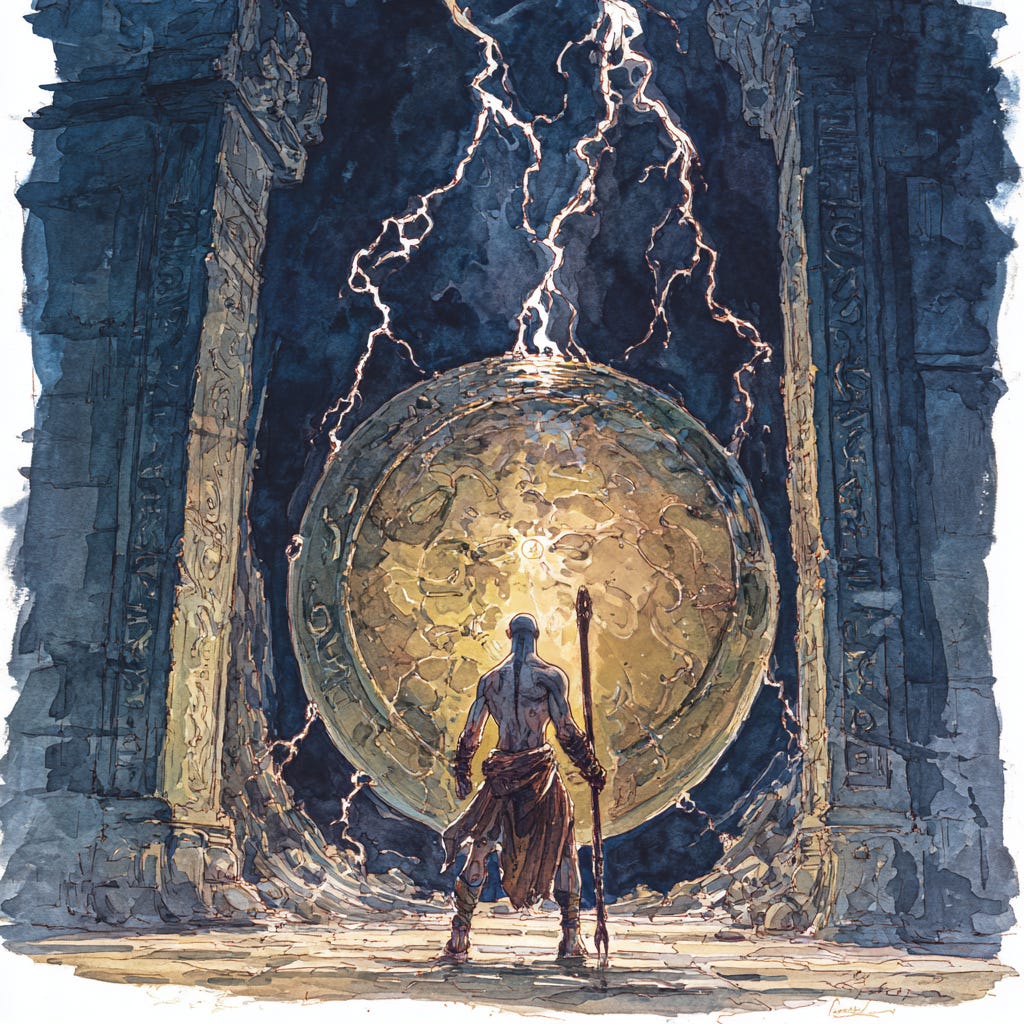
And at the height of her power, she performed the feat the whole campaign now orbits: she bound the Thousand-Year Storm to herself. “When the Indrasduthir worked her magic upon the Thousand-Year Storm, she was like unto a god, and the spirit and she shared one flesh and one mind” (Session 11.4).
Then she fell. Her tower on the Flats — a pillar of stone and makerglass, rising to touch the very vault of heaven — was cast down in the slave rebellions that also toppled the Stone Lords (Session 6.2). Vahid saw the moment itself in his death-vision: “a terrible fire roars down from the sky, sundering the topless tower like a child’s fragile creation” (Session 15.2, Part 3). The barrow carvings name the hand that did it: Yezkial the Thrice-Betrayer was a servant to Stormcatcher herself, and it was he who led the attack that cast her down (Session 15.6). Her nine champions ruled on as tyrants until the Hillfolk hero known as Kirs the Crownthief stole the crown that made them and hid it in the deadliest place he knew (Session 8.4): the Barrow of the Thrice-Betrayer.
When Vahid and Mado went into that barrow to recover the crown, they learned the strange and terrible truth: Stormcatcher isn’t truly dead: “Stormcatcher did not die, little vessel. She spread herself to the four winds and the nine thunders. As long as the storm rages on the Flats, Stormcatcher lives” (Session 15.6). She scattered her mind across the storm-spirits that served her1. Any squall on the grasslands may carry a shard of the greatest of the Makers, waiting for a vessel clever or foolish enough to take it in.
The Thousand-Year Storm and the hdour
The Thousand-Year Storm is a powerful spirit — in the spirit-talker Karan’s words, “an empress of the sky... born once in a hundred generations, to rule in the heavens for a single day” (Session 7.6). Her song enthralls the other spirits of the sky, drawing them into her train and her service. She is perhaps the mightiest elemental being the world has ever seen.
And she is afraid. A storm born to live a single day has exactly one enemy: “I have glimpsed the darkness beyond the Last Door through mortal eyes, and I too am afraid... Cruel nature decrees I live only a day and a night before my storm goes quiet for another age” (Session 7.6). She learned to fear death while bound to Stormcatcher, and her fear led her to make a terrified, hunted young spirit-talker an offer: “Promise me, mortal. I will deliver you and your master from your enemies, and you will deliver me from death” (Session 7.6).
The boy said yes. We lived that night from inside his skin, courtesy of a vision from the fate-tree: the storm entered his body, he slew the Heoling witch hunters who were hunting him, and when his master Karan drew the spirit back out of him and into an Old Masters’ binding crystal — intending to shatter it and let her pass gently from the world — the boy killed him rather than let the storm die. That boy grew into Cirl-of-the-Storms, and everything he has done since—the murdered travelers on the Makers’ Roads, the feuds kindled between the bands, the burning of Gordin’s Delve—is in service of the promise he made her. Cirl now possesses her stormsong, allowing him to command lesser storm-spirits. His branching scars are the price of carrying a power his flesh was never prepared to hold (Sessions 7.6, 17.1).
Where is the Thousand-Year Storm now? Session 17.1 answered it through Katrin’s eyes: beneath an Old Masters’ watchtower in the Steplands, at the heart of the sorcerer’s mustering host — “an electric presence in the unseen world, ancient and restless. The Thousand-Year Storm, caged in the Old Masters’ crystal, waiting.” Some nights, when the wind comes off the hill, Katrin can hear her song.
When Cirl and the Storm were one, he tells us, “her memories of past lives became my own, and her destiny became mine” (Session 7.6). The Thousand-Year Storm was Stormcatcher’s own bound spirit, the vehicle of her apotheosis. She is the crown jewel of everything Indrasduthir was, the strongest piece of the Maker that still remains.
Vahid’s transformation
Vahid has also been chasing Stormcatcher’s legacy alongside the hdour, though he did not know it until recently. Let’s look at the steps the Seeker has taken:
Step one: Odo’s Lair, and the first binding: Deep beneath the Delve, with the Howling Curse loosed and the party surrounded, Padrig shouted the words he has begun to regret: “Vahid! Hold nothing back! Without your magic, we are lost!” (Session 13.6). And Vahid didn’t. He had seen, in the fate-tree vision, exactly how a hdour binds a storm into his own flesh — he knew the trick of it, as though he had done it himself. So he called the ancient spirit fettered in his sky-blue cloak — His-Laughter-is-the-Thunder, that lordly, barrel-bellied deva we first met in Session 7.5 — and opened his mind. “Come. Let us be one.” Spirit meets soul, and Vahid becomes the storm (Session 13.7).

His storm consumed Odo Thriceborn. And it was here that the gestalt between Vahid and Stormcatcher began. Hovering over the fighting pit, Vahid surveyed the arena and, for a moment, didn’t see his friends and allies, but instead his subjects. Strange memories flooded him — mountain peaks falling short of his commanding heights, fields of grass bowing rhythmically before his majesty, ant-sized mortals praying for his rain as though he were Tor himself. He gained the storm’s power that night, and a new Instinct on his character sheet: Hubris.
Step two: the duel above Gordin’s Delve. When Cirl came to burn the Delve, Vahid’s task was to hold back his power—the Seeker matched his own will against a host of enslaved storm-spirits. Then Cirl called to him across the storm, offering brotherhood, destiny, the legacy of Indrasduthir — and the part of Vahid that was already a storm-spirit answered. He rose to meet the hdour over the burning town, binding first one spirit into his body — “opening the wound in his mind that allows the spirit’s pneuma to seep in” — then a second, his body “a riot of pain and power” (Session 14.5, Part 2). He unleashed His-Laughter-is-the-Thunder as a lion-headed asura pouring lightning from its jaws, and the bolts fell on Delvers and Stormcrows alike. On the great stair, Padrig watched the white fire rain down on friend and foe and whispered: “No, Vahid... what have you done?” (Session 14.6).

The duel ended in Vahid’s defeat. Cirl, armored in ancient arcana, cast him from the sky — “Die now, and in your sacrifice, let Stormcatcher be reborn!” Vahid barely survived. In the days after, when Anwen pressed him, he did not repent his use of forbidden magic — he doubled down: “I intend to walk the path that Indrasduthir walked before me. Turn back if and when you must, I will go onward” (Session 14.7, Part 2).
Step three: death, and the true binding. At the Ruined Tower, the Pale Hunter’s black blade found Vahid’s heart. He stood before the Last Door; the Lady of Crows beckoned. And then Cerys’ second prophecy paid off in full: his storm-spirit, which had learned to fear death through his eyes, refused. “Not yet! Not yet! We cannot die with our fate ungiven!” It tore free of the ruined Flying Cloak that bound it and flooded Vahid’s corpse with vis, dragging him back into “agonizing, unnatural life” (Session 15.2, Part 3). What woke among the shattered stones was not quite Vahid. His hair burnt to ash-grey, his wounds smoking rather than bleeding, his memories “blending like brackish waters” with those of the spirit. When Anwen found him, he described his own condition in the third person: “The spirit, His-Laughter-is-the-Thunder, sustains the man, Vahid ebn Sulaim... It is the spirit’s wind that fills the man’s lungs, the storm’s spark that stirs the mortal’s heart... Vahid is only memories, now” (Session 15.3). Anwen refused to hear it, telling him “You are Vahid,” and he chose to agree. But Vahid’s new life would be short-lived, without intervention: “The spirit’s vis sustains this body, but this body cannot sustain the vis” (Session 15.3). Without the arcanum beneath Stonetop, the borrowed life would burn his flesh away.

The revelation in the barrow. The desperate quest for Stormcatcher’s Crown brought Vahid and Mado to the tomb of Yezkial the Thrice-Betrayer — and the wight recognized his visitor: “Stormcatcher... You cannot fool me, Indrasduthir, greatest of the Makers. Returned in new flesh, as you always schemed” (Session 15.6). This is when we — and Vahid — learned the truth of the Stormcatcher’s plan: The thing sustaining the Seeker is not merely a lordly weather-spirit. It is one of the spirits that served Stormcatcher, and it carries a fragment of her mind. Vahid put the pieces together on the spot, standing over the pinned corpse of her betrayer: Cerys said in binding the storm, spirit and man become of one mind... In the elder days, Stormcatcher bound many spirits to herself, and through them, she lives on. Mado heard every word — and chose, in one of our reader polls, to keep it from his mother, telling only Anwen: “It is not only the spirit that has a hold on Vahid’s mind — it is Stormcatcher herself, the ancient” (Session 16.6).
Taking on the storm-markings. Back beneath Stonetop, Vahid donned the barbed crown, his blood woke the sigil, and lightning tore through him and into Anwen. The device did two things at once. It remade Vahid’s flesh so that it could survive the spirit dwelling in it, saving his life. And it made Anwen the first of the Nine Thunders come again: storm-marks searing themselves along her arms, the fury of the storm flooding her mind. “I am the Thunderhead. Woe to those who threaten my home” (Session 16.1). She ran wild onto the Flats that night and annihilated a twelve-rider Stormcrow scouting party without taking a scratch (Session 16.2). Vahid rose from the cistern restored — “more than restored.”
A brief aside: Why doesn’t Anwen have a spirit in her? Sharp-eyed readers may have noticed a wrinkle here, and rather than paper over it, let’s dig it up. When the party first learned of the storm-markings, their stated function was armor for spirit-hosting: “the storm-markings it produces will protect him from the ravages of hosting a spirit within his physical body” — that’s the intelligence on Cirl’s plan from Session 9, and it’s exactly what the markings do for Vahid, whose marked flesh now sustains both the vis and the pneuma of His-Laughter-is-the-Thunder without being unmade. But Anwen stood in the same chamber, took the same lightning, wears the same branching marks — and hosts no spirit at all. No second voice in her head, no bleed of ancient memories, no lordly pride that isn’t natively her own. She was seared with the storm’s vis — its raw power, written into her body’s pathways — but not joined to any storm-spirit’s pneuma, its soul. She has the storm’s strength; Vahid has the storm’s strength and its soul.
Is that distinction rigorous, on the page? Not really. The Nine Thunders material was conceived as just storm-powered warriors and the vessel-architecture reading arrived later, as Vahid’s arc developed and I needed the markings to do double duty. If you squint, you can see the seam — one device, one set of marks, two quite different miracles. I’ll own that this is sub-optimal worldbuilding, built in flight. But it’s a patch in service of something I care about more than clean metaphysics and magic systems. Two PCs shouldn’t have the same story. If Anwen gets a piece of Stormcatcher, she is forced into many of the same story beats as Vahid, rather than exploring her own.
Deeper gestalt: walking in Stormcatcher’s steps. Summoned to the ruined Delve by Judge Abrim, Vahid descended from the sky like a god, while the survivors cried “Stormcatcher! Stormcatcher has come!” — and he did not correct them (Session 16.3). In the Forge Lords’ archive beneath the town, he could read their language “as easily as a man reads his own name,” because Indrasduthir sojourned there a millennium ago and he remembers it — remembers flying over the valley, dictating notes to a scribe-tulpa, arguing with the builders about irrigation channels (Session 16.4). And as her memories flow in, his own drain away. The most visible sign of this was the loss of his Polyglot move: his command of Marchsprech, Sunghaian, and even Lygosi, the tongue his mother spoke to him as a child, slipped away, while the dead tongues of the Makers remain (Session 16.4). He caught a spring storm in the Azure Hand and gave the Delve a season of bountiful weather; the Delvers honored him as a savior (Session 16.4). “I have given them rain,” he told Anwen on his return, and it worried her: he sounded like a king, or a demigod (Session 16.6). His old friendships strained against his new mien—Padrig laid hands on him during a heated disagreement (Session 17.3); the cold calculation with which he stoked Anwen’s wrath at Erwann’s camp, because her fury was tactically useful (Session 17.4).
What’s next: the sorcerer’s plan
So now we can state Cirl’s plan plainly, the way Vahid understands it. He has the host — six hundred riders strong (Session 17.5), more spears than any living Heoling has seen raised (Session 17.1). He has the Thousand-Year Storm, caged in the Old Masters’ crystal beneath his watchtower, singing to be let out. What he does not have is a body that can survive binding her into his flesh. The storm-markings are the missing rung: the arcanum beneath Stonetop, worked by Stormcatcher’s Crown, would remake his flesh into a true vessel — “He intends to unite himself with a spirit called the Thousand-Year Storm, granting her long life and him power beyond reckoning” (Session 9). That is why every road on his map runs through our village: the standing stone at the village’s center shields Stonetop from his magic, and so the sorcerer must come with his army (Session 17.4, Part 1).
A storm-marked Cirl, with the Thousand-Year Storm bound to him, wouldn’t just wield Stormcatcher’s legacy. He would become her, at least in part—he would have her memories, her craft, her ambition— reborn in the body of a Hillfolk warlord with a host at his back and the grand ambition to lead the tu’d back to its old brutal glory.
Katrin is in his camp to stop exactly this, by freeing the Thousand-Year Storm: “She must be freed and allowed to pass from this world. Nothing else matters” (Session 17.1). Mercy for the empress of the sky — and with her passing, the greatest shard of Stormcatcher gone beyond every ambitious mortal’s reach, for another hundred generations.
And if Cirl falls?
But what if Cirl falls? His host is scattered; the Steplands and Flats are at peace again. The crystal still sits beneath the watchtower, and inside it, a frightened sky-empress with a day to live and a mind full of Stormcatcher’s memories.
And in Stonetop there is a man who already wears the storm-marks. Whose flesh has already been remade to catch the storm. Who wears the Crown, and carries the key to every one of Indrasduthir’s works, and hears her memories as his own. The only proven vessel in the world. This is why Vahid is playing a little coy about Katrin’s reasons for joining Cirl. This is the secret he is protecting, perhaps without fully knowing why. But if Anwen, Padrig, and Mado ever saw the possibility clearly, they might not see their old friend. Only a threat as dangerous as Cirl.
Will Vahid have the opportunity to take up Stormcatcher’s legacy? And if he gets that opportunity, what will he do? That’s what we must play to find out!
LATE EDIT: Reader Alexander Williams points out something that made me literally facepalm for missing it. Anwen is also a ready vessel for Stormcatcher’s spirit.
I’ll reproduce my reply from the comments: On the one hand, Anwen, as someone who has never hosted a spirit (or even conversed with one) would perhaps be easily overwhelmed by Stormcatcher’s presence. On the other hand, her WBH moves envision someone with a deep resolve that can resist undue influence. What could happen? Another set of questions we can play to find out!
I loved this - I remember most of the moments as I read them, but a couple certainly escaped me, and I definitely hadn't put some of them together...
I suppose this does gloss over the fact that with the description given, as another spiritualist once said, "there is another." There is someone who has flesh already prepared to resist the inhabitation of a powerful storm spirit, and who currently stands empty. Anwen remains a viable vessel. Perhaps unconsciously, that's exactly what Stormchaser in had in mind.
To put it in more modern parlance: always mount a scratch monkey.